Thursday, 24 October 2013

57th LFF Review: Gone Too Far


Director: Destiny Ekaragha

Writer: Bola Agbaje

Starring: Malachi Kirby, O.C. Ukeje, Michael Maris, Shanika Warren-Markland, Adelayo Adedayo

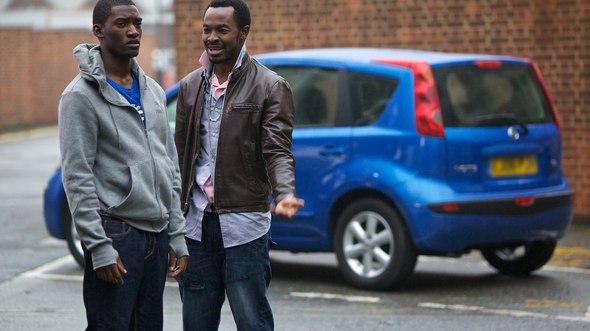
Synopsis: Once his visa is approved Iku (O.C. Ukeje) comes to London to join his family. His brother Yemi (Kirby) has to show him around and get to know him, but each second with Iku drives Yemi mad.

Gone Too Far’s Peckham-based comedy is anything but humorous. For people living in the area, or similar estates, those with Nigerian family, or fans of simplistic formulas the film will entertain. Nevertheless, judging it from one perspective sees it as a horrific tale of violence, racism and “broken Britain”.

Having won an Olivier award for the play of the same, you’d imagine there to be a lot of heart and depth to this tale of conflicting cultures. Writer Bola Agbaje once said she’d written the play for her parents, a telling problem for the film – shown to a certain audience this would mean something, but most will view it as off-key and bland.

We follow Yemi, a selfish teenager who has to look after his brother after his arrival from Nigeria. As the two brothers head out on an errand for their mother things start to go awry. Almost structured like a Peckham-based Baby’s Day Out featuring an out-of-towner Nigerian instead of a toddler, Gone Too Far is beyond predictable. Certain characters come and go without warning, but the six main characters have unmistakably conventional paths to follow. Formulaic as it is, it doesn’t take away from the fact that there are only two pleasant characters out of the six, making it a taxing viewing experience.

The film shows a comic side to street thugs who are anything but likeable. The notion that any person willing to kill someone (be it the action or a mere threat) could be funny is perplexing. Whilst these characters are not the focus, they are granted a lot of screen-time. Another character called Armani (the self-obsessed, dolled up love interest), given an important strand of the storyline, is yet another figure scratching away at your sense of sanity. Each time she’s on screen you await her comeuppance; the fact that she gets off lightly may be true to life, but in relation to the other positive resolutions, it’s a tough pill to swallow.

The overall message that people are too narrow-minded and often ignorant of each other’s cultures is strengthened at the end, but not before an hour of confused preaching. The jokes aimed at Iku for having an odd fashion taste is inherently childish. What’s more, the two thugs characters who enjoy smoking weed, stealing, and beating others up are occasionally presented as funny – incorrect. It’s distressing to see these sort of people treated in a forgiving light when they are part of problem with this country. If the film manages to discredit their place in this country, then it’s working on some level.

Puerile in its characterisation, Gone Too Far is a hopeless satire on the state of country. It adds to the sub-genre of British cinema focused on council estates, injected with a paradoxically quirky tone, too low-brow and lacking. For some this film will seem profound and entertaining; with the right audience it’ll work. Nevertheless, on the whole, it’s a disheartening look at our developing culture.
*

Also posted on LiveForFilms

57th LFF Review: All Cheerleaders Die


Directors/ Writers: Lucky McKee, Chris Silverton

Starring: Caitlin Stasey, Sianoa Smit-McPhee, Brooke Butler, Tom Williamson, Reanin Johannink

Synopsis: After a freak accident where the head cheerleader is killed, outsider Maddy (Stasey) joins the team, intent on bringing the airhead troupe down. Before Maddy can sabotage the lot, the football team are involved in an altercation which changes everything for both groups.

Had this film taken itself seriously it would be beyond absurd. As it stands, All Cheerleaders Die is tongue-in-cheek and conspicuously silly. With its combination of Wiccan magic, vampirism and Mean Girls high-school humour, this is a black comedy a touch different from the rest.

Handheld camera work at the start has you rolling your eyes at what might be another found footage horror film, but this only a brief exercise in a tired style. It then changes to a regular mode of filming, never attempting anything too grand or stylish. What helps All Cheerleaders Die is directors Lucky McKee and Chris Silverton keeping it all grounded. Sure, it includes some supernatural exuberance, but within the confines of its budget you aren’t seeing superfluous flair or stabs at something elaborate. 

This extends to the performances that, other than Sianoa Smit-McPhee, aren’t over acted. At certain points emotional outbursts are melodramatic, excusable only for the fact that it’s after a Wiccan transformation. Full moons and witch stones appear sporadically from the beginning, subliminally preparing you for what eventually comes. Characters are part of this strange world too, accepting the craziness around them quickly and without much question. You are willing to buy into the witchcraft partly because you have no other choice. Each cheerleader decides it’s the new norm, as do the football team villains, insisting you should too. Furthermore, you are conscious of the formula whereby a bloodbath will erupt before you and a hero will rise. Without spoiling things, it doesn’t conform to your expectations, weirdly leaving you wanting more.

You can either relax your brain in order to enjoy All Cheerleaders Die or sit uncomfortably for 90 minutes. Its daft mixture of horror traits and high-school politics is amusing, not be taken seriously. Guys will find watching beautiful girls for an hour and a half decent enough, whilst the girls can take pride in its strong female figures and boys versus girls outline. It’s no game-changer or feminist turning point in cinema, instead, harmless, irreverent fun.

*** 
Also posted on LiveForFilms

The Walking Dead Season 4 Episode 1 Review

“Previously on AMC’s Breaki---” Hold on a minute, that brief sound clip will never again be heard on live television. AMC has said goodbye to the Vince Gilligan masterpiece but still retains the likes of Mad Men and The Walking Dead. Whereas Mad Men has a more niche audience, The Walking Dead grows ever-popular, with a group of geeks in adoration of their favourite characters (we’re looking at you, Daryl). With that in mind, The Walking Dead’s fourth season started with a 16.11 million viewership, the highest it’s ever had. It will never see the same hype as something like Breaking Bad, though its continual effort to be seen than something more than just “that zombie TV show” is very commendable. Season 4 begins in a far less exciting manner than the third season’s opening, yet is still able to have us completely transfixed.  
Major spoilers follow

AMC’s catalogue of soundtracks eclipses most other networks. Thomas Golubic, “30 Days Without an Accident’s” music supervision begins the episode, with a little ditty: “Precious Moments” by The Stanley Brothers. The irony is palpable – as Rick takes out the headphone buds, the sound shifts to that of growling, scratching Walkers – that memories in the Walking Dead’s world are mostly cutting as reality becomes filled with the undead. Golubic had also worked on Breaking Bad and Six Feet Under (to name just two), a great crew member, able to make a scene work on music worth alone. It sets up the workaday nature of the new colony, with that eerie quality that no matter how cheery you can try to be, death still surrounds everything.

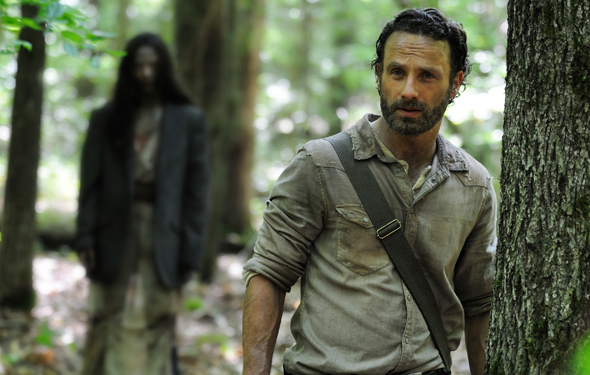
Apart from the brief musical epilogue, season 4 starts with a harrowing image of an eyeless zombie “watching” Rick. Bleeding eyes and absent pupils, it sends a jolt through you; the work of the show’s master make-up team. Foreboding and distressing for relatively unknown reasons (as the show’s audience has grown used to the macabre), it is a moment than seems very definitive – an omen of what to come.

So in the six/seven months since we left off apparently a fair few things have happened. These mostly relate to relationships forming and duties assigned. Tyreese is with a beautiful woman named Karen, Beth is with a muscular newcomer called Zack, and Carol and Daryl may or may not be a couple. In addition, Everybody Hates Chris’ Vincent Martella shows up as Patrick, who will become the final moment’s most integral part. Lastly, established characters get given some development, such as Bob (The Wire’s Lawrence Gilliard Jr.), Michonne (returning from unsucessfully hunting “him” – the Governor), and Daryl (as much of a celebrity within the show as he is outside of it).

In terms of hunting, there are no suspecting villains ready to find and kill (though you can bet the Governor will return) so it’s only food needing the group’s time and effort. Hershel and Rick head out into the forest for game and vegetation whilst Daryl, Tyreese, Zack, Bob, Glen and Michonne go looting a supermarket. As Hershel leaves Rick, our protagonist stumbles on a starving, filthy survivor out in the woods. Greyed and skinny, she reeks of desperation and pity. Rick, helpful as ever, offers her food and a chance to bring her back to the prison.

Rick’s stint with the stinky Irish woman is a slightly confusing part of the episode – Clara takes him to her camp (for an interview situation, where Rick will determine whether Clara and her husband are safe for his sanctuary) where he finds her talking to a head under a blanket. Not easily distinguishable under that cloth, the decapitated husband is a mere mystery until a brief shot at the end of the scene. Her reasoning and emotions are somewhat baffling – her will to survive until meeting Rick and then offing herself. Rick stands there upset and perplexed by her motivations, finally asking her the interview questions that have only slight bearing on the poignancy of the programme. Her story would have been quite interesting to have learnt about – an exile of her homeland, carrying the head of her husband around, surviving on barely anything – but she’s dropped after such little screen time. Fans of the show should know this to be realistic and in-keeping with Kirkman’s universe, but on occasions there are missteps – Clara being one of them. 
Meanwhile, Daryl and company head to the store. Starting off fairly lacklustre, the camera pans up from the door they entered in to the roof – packed with zombies and a crashed helicopter.  It’s nothing jaw-dropping, nor is it when Bob makes a ruckus toppling a shelf full of alcohol (a great piece of storytelling where we realise Bob’s an alcoholic, faced with a haul of free wine). However, the damp, sunken tarp, holding the weight of 20 or so bodies and a helicopter means the undead fall through into the shop. Bob’s liquid temptresses become a danger not only to himself but those around him – an implicit part of the episode’s drama and action.

As the hoard drop from the ceilings the scene suddenly goes from tedious to tense. The effects and stunt work usually have their shining moment at some point in an episode and this is it. Just before the break, one zombie falls to the camera (a skewed POV shot of Bob’s), growling as he heads into focus. Put simply: it looks fucking cool.

Effects work are similarly superb, with purely gross moments of gore. Skin ripping away, heads being pealed apart and explosions of impact on the decrepit bodies are each scarily real. It adds to the electricity of the moment, where everything seems too messy.   

Daryl and Glen – two key players in the cast – have their moments of peril, worrying for a show that is known for killing off anybody. Fortunately they survive, something that cannot be said for Zack. As the helicopter looms over the crumbling roof, there is no time to save him and the only saving grace from it all is the helicopter would instantly smush him. 


“30 Days Without an Accident” gets its name from Beth’s reaction to Zack’s death. Not “crying anymore” – changing her X amount of “days without an accident” sign back to zero. Her maturity in accepting his death follows the tone of the developing show – now news such as Maggie not being pregnant, Tyreese fearful of walkers in most situations and Rick’s constant fear of losing people is dealt with more philosophically.

The Walking Dead can be the best thing on TV, and merely average other times. Season four shows plenty of promise, without being a game-changer. It’s the final shot – the cliff-hanger – that means business. Patrick, coughing and sweaty, stumbles to the bathroom where upon he drops dead. Closing his bleeding eyes (like that of the eyeless zombie outside), he lies there deceased. Until, of course, those eyelids open once again, revealing the smoky glaze of his lifeless pupils. He’s a walker, inside the sanctuary, probably set to cause some trouble. Episode 2, we’re waiting...

Also posted on Flickering Myth

The Wicker Man Final Cut Review


The Wicker Man: The Final Cut DVD
Director: Robin Hardy

Writer: Antony Shaffer

Starring: Edward Woodward, Christopher Lee, Diane Cilento, Britt Ekland, Ingrid Pitt

Synopsis: Police sergeant Howie (Woodward) is sent to a remote Scottish island to search for a missing girl. His inquiry proves fruitless once he realises the whole town seems to covering something up.

For the meme generation, the passing mention of The Wicker Man will more likely involve people shouting, “Aaahh, the bees!” than someone commenting on the classic 1973 horror. Aspects of Robin Hardy’s The Wicker Man have aged, it must be said, overshadowed somewhat by Nicolas Cage’s modern remake. To stress, overshadowed in the sense that Cage’s version was so absurdly awful it’s distinctly soured the title.

The rerelease of the original aims to rid the memory of the remake, an ambition easily accomplished. The restored version (having been reviewed on DVD) is not as magnificent as more recent restorations. It has enhanced the sound and removed the scratches, but colour grading is not as polished as would be desired.  The special features and the trinity of versions included in the new release is the defining aspect – a final, complete, Wicker Man.

The Director’s Cut runs wonderfully smooth – without the jagged flashbacks and clumsy editing seen in previous versions – a triumphant example of the mystery/detective narrative. As normal as the form appears, what is included within it is not. The film features an island of folk-loving townspeople, who are bound together by paganism unknown to the tragic Howie character.

Woodward as the pious and stoic lead is terrific. Dogged and doomed, he leads us through a series of interviews with the islanders, leaving the audience to pick up on things he doesn’t see. As the patsy, he gains immediate empathy, with the end bitterly upsetting. Christopher Lee as his foil has little screen-time and achieves a mysterious quality perfectly fitting for the film. It seems that even as the end answers some questions, Lee’s Summerisle is still a questionable figure. You get the satisfaction of knowing and liking one character, and despising and querying the other. Woodward and Lee made a superb hero/villain duo, immortalised by their only cinematic coupling in The Wicker Man.

Heralded the best British horror film by many, The Wicker Man does indeed boast an exemplary script (by Sleuth author, Antony Shaffer) and impeccable direction. Woodward and Lee are characteristically brilliant and the atmosphere each man creates (insecurity and danger, for example) is timeless. The film will last for decades to come (even if some of the Morris dancing and folk chants do not), now serviced with its “definitive” legacy.
****
Also posted on Flickering Myth

Runner Runner Review


Director: Brad Furman

Writers: Brian Koppelman, David Levien

Starring: Justin Timberlake, Ben Affleck, Gemma Arterton

Synopsis: Talented and involved with gambling, Rickie (Timberlake) decides to bet for his entire university funds. At the end of the long game he loses and thinks it’s all foul play. Seeking out the owner of the poker website Ivan Block, (Affleck) he makes a good impression and becomes one of Block’s employees. Swimming with sharks, Rickie starts seeing red waters and sensing danger to a point where he starts questioning his new lifestyle.

Taking on the odds is a risk few care to take. At the core of Runner Runner’s thematic is the party-life and perils of gambling. It’s a dark premise lightened by sunny, sexy sheen of the film, yet maintaining some elements of authentic tension and malice.

Perhaps unbelievable for some cinema-goers, the best feature of Runner Runner is man-of-the-moment Ben Affleck. He adds the aforementioned malice, playing a seemingly charitable casino owner (yes, that oxymoronic quality works) who uses his power cruelly at points. Affleck has not played a villain for a number of years and it’s clear to see him relishing the opportunity. There’s a casual cockiness to his performance, easing back from his multi-awarding winning directorial efforts with a persistent smirk. Affleck as the supporting actor will be under a lot of scrutiny – this being his first role since the Batman announcement – and this extraneous aspect is actually quite fun to think about during the film. He pulls everything off and gets many of the best lines and scenes so it’ll hopefully put a halt to all the hate.

On the whole it seems all cast members are relishing the high-budget and location work. Whereas this type of money-laden project would result in some laziness (acting, directing, editing, etc) everyone seems on form here. Timberlake continues to prove his multi-million dollar worth both in music and acting, leading the film confidently. It may be that it’s not a humongous stretch for him to play a young go-getter but there’s never a misstep in his acting. Arguably, he gets very few demanding scenes but that’s a wrong on the writer’s half rather than his.

The third and most glamorous cast member is Gemma Arterton. Very British in her ways (with a brief mention of beans and toasts added in for her character), Arterton never seems out of place in the glitzy Hollywood startlett role. If anything, she overshadows past American actresses attempting the same. Her style of acting is subtle and sincere, whilst her beauty is enhanced only by sublime genes and some (possibly fake) tanning. Whether or not her character was originally penned as a token dame, Arterton adds strength and depth. It’s a shame that she is eclipsed by various plot points that don’t involve her as her screen presence boils down to a measly 40 or so minutes.

Plot-wise the film is slightly above average. It’s exploring multifaceted criminality but, like most Hollywood dramas, dilutes it down for a general demographic. The stars will be enough to draw in the crowds and for that reason the writers and director have subtracted a lot of the profound elements. So for an easy, entertaining watch it’ll check most of the boxes.

***
Also posted on LiveForFilms

Machete Kills Review


Director: Robert Rodriguez

Writer: Kyle Ward

Starring: Danny Trejo, Michelle Rodriguez, Demian Bichir, Mel Gibson, Amber Heard, Sofia Vergara, Charlie Sheen, Lady Gaga, Antonio Banderas, Walton Goggins, Cuba Gooding Jr.

Synopsis: Machete (Trejo) is hired by the President of the United States (Sheen) to stop an arms dealer in Mexico intent on launching a missile at the US. Once he finds him, he discovers a larger criminal underground...and outer-space...ground!

It’s no surprise to see Machete back on our screens; at the end of Machete we were promised a return of the Mexican legend in Machete Kills and Machete Kills Again! It is a wonder, however, that Robert Rodriguez has decided to set his attention on the scratchy, blood-soaked B-movie once more. That said, from someone who made Desperado, From Dusk Till Dawn and Sin City has additionally directed all three Spy Kids movies. He isn’t someone to pass down a sequel, however ridiculous it looks in his filmography. This continuation of the fake-trailer-turned-movie was made at a budget of $20 million, a high cost for brief side-splitting inanity in amongst pure trash.

Realistically, most of that $20 million went toward the cast of huge names. There is little else to show for it with effects and basic filmmaking lowered to sub-standards. It’s easy to say, “It looks bad for a reason – that’s its aesthetic”, but whereas Machete mostly aimed at visual ineffectiveness, this one looks as though it’s trying to appear cleaner, with a script noticeably lousy. It ends up looking like a film of the 1950s desperately trying to look epic, crossed with the appearance of a grand 21st century blockbuster.

Set-pieces, the cast, the violence, and the jokes are all overstated – it perfects the “bigger, bolder, better” essence of a sequel. Machete was a terrible film, and so is this, but it is enjoyable. A guilty pleasure in every drop of its (extremely) red blood, many will find this frenetic follow-up unaccountably amazing. Losing yourself is the trick to sticking with it – ignore every ethical and rational oversight and it’s bearable.

Majorly helping the film are select members of the cast clearly enjoying letting themselves go. Oscar winning and nominated actors such as Demian Bichir, Mel Gibson, Walton Goggins and Cuba Gooding Jr. are simply brilliant in their respective roles. The former, especially, brings such energy to the film he basically steals the show. Other notable inclusions such as Charlie Sheen and Antonio Banderas bring a certain charm to the film – with Sheen as PotUS so wonderfully tongue-in-cheek.

Having the story actually go somewhere (a path clearly defined by the trailer for the third film as the prologue) helps somewhat too. There is a goal and incentive written in (surprisingly) so it doesn’t zigzag all over the place. If the first film was foreplay for the climatic third entry, this film is a steady shag.
Machete Kills does what it sets out to do, so marks for its self-referential absurdity. It may highlight money and time misspent – made for fans only – but its impishness has a certain worth. If you can’t like it or love it whatsoever, just think: one more film and it’ll all be over...maybe.

**

Also posted on LiveForFilms

The Lone Ranger Review


Director: Gore Verbinski

Writers: Ted Elliott, Terry Rossio, Justin Haythe

Starring: Armie Hammer, Johnny Depp, William Fichtner, Tom Wilkinson, Ruth Wilson, Helena Bonham Carter, Barry Pepper, James Badge Dale

Synopsis:  After his brother is killed, John Reid (Hammer) seeks vengeance. On his journey he finds Tonto (Depp), similarly on a quest, and the two team up to fight injustice and conspiracy in the American West.

Forgotten for many years, stuck in development hell for a decade, The Lone Ranger seemed destined to stay remembered only as the early incarnations. Casting and director rumours flew around for what seemed like ages (George Clooney was, at one point, down as the masked man) until we found ourselves watching Gore Verbinski tackle the classic adventure with Armie Hammer and Johnny Depp in the lead roles.

After Rango – a beautifully realised, surrealist Western for children (that must have been difficult to pitch!) – the prospect of Verbinski handling the epic American West with live-action and well-known characters seemed nothing to fret about. If anyone was destined to make The Lone Ranger Verbinski landed that role immediately after Rango. The final outcome is not up to par with his last film or the first Pirates of the Caribbean but it’s equally fun, silly and visually stunning.

Apart from Verbinski linking Pirates, Rango, and The Lone Ranger there is also the million-dollar name Johnny Depp attached to all three. A lucky charm for Verbinski and many others who have worked with him, Depp is not the lead here and, surprisingly, never steals the show. Try as he might to inject some odd humour and strange physicality to scenes, Tonto is quite clearly the sidekick. Armie Hammer may not have top-billing against someone like Depp but it’s tough to forget that this is his film. Even as Tonto recalls the story (the film bookended with the recollection), you are already accustomed to the Ranger’s iconography with the small child being told the story costumed up to look like the Lone hero.

John Reid has to become The Lone Ranger, much like Hammer has to become the lead. He’s not a familiar face to most audience members and has clearly got to earn that top billing title. Still, with his part in this that should never become a future issue as Hammer unquestionably delivers on his lead duties. Sets and set-pieces may be exuberant and costly-looking but the casting is not something to match the aesthetic expense. Sure, there are names like Depp and Helena Bonham Carter attached (though Carter gets perhaps one of the smallest parts) yet looking elsewhere you will find Tom Wilkinson, Ruth Wilson and William Fichtner. Cast your minds back (no pun intended) to the Pirates series and you had people not typically sort out for big blockbusters. Even Depp at that stage was a curious addition to a Disney film, a place in Hollywood that now seems nothing but ordinary. It’s Verbinski’s incentive that sees these huge films Barry Peppered with character actors; it work wonders to not be momentarily distracted every time a recognisable face appears.

Casting his worlds is never what garners the greatest attention Verbinski seems to take, arguably. In his films he dresses and designs his diegetic landscape with meticulous detail. Some many shots show the tiniest of details (from dirt under fingernails, the smear of lipstick, to the fine silverware of an elegant table) that are absolutely stunning. That level of attention for the mise-en-scรจne is seldom seen in contemporary cinema, mostly reminiscent of classic directors such as Douglas Sirk and Nicholas Ray. On top of set-design and costume, Verbinski has equally focused on the surrounding environment. The Fordian backdrops of Monument Valley, Leone-styled train station scenes and postcard pictorials of the old West are captured beautifully by cinematographer Bojan Bazelli.

The reminder to all those famed Westerns has not been incorporated accidentally, working towards the film’s greatest asset – the revitalisation of classic adventures and Westerns. Take the film seriously and you fail to see the enjoyment of it all. There are moments where the writers can’t help impart some historical significance and these only occasionally work. A horrific massacre shown mid-way through of a tribe of Comanches is shocking and powerful; what does not help is ignorance towards that destruction when a joke about a horse quickly follows after. This as the purest example of two tones not blending together, yet Verbinski is mainly set on thrills and comedy.

It’s never laugh-out-loud funny, possibly due to the partnership of Hammer and Depp taking an hour to achieve a noticeable chemistry. Nevertheless, there comes a point in the film where the William Tell score/Lone Ranger theme erupts, the Lone Ranger and Tonto pounce into action and excitement pulsates through you. The big set-pieces are often stunning (with the final fight incredibly well story-boarded and executed), constantly keeping you entertained.

As much as the early scenes can be enjoyed with the Lone Ranger and Tonto, its about them so some may struggle with the first hour. The relationship with the Lone Ranger and Tonto takes its time to germinate, though it does end with a strong bond between the two. It deserves its sequel to expand on the pair along with Verbinski’s gorgeous depiction of the West. Conversely, it deserves to continue on with the tradition it’s campaigning for – the classic adventure with heroes, sidekicks, villains, love interests and escapades.

The violence maybe a little too strong for younger audiences (12A being a tame certificate for some scenes) and the aforementioned love interest may not mean much, yet this is a kids’ film that relishes the inanity and action. Much like the boy being told the story in the film, this will give children a new hero to worship (together with a new Halloween outfit for the parents to buy) and a genre and figure they may have only heard about from their grandparents.

****
Also posted on LiveForFilms