Thursday, 24 October 2013

57th LFF Review: Tracks


Director: John Curran

Writer: Marion Nelson

Starring: Mia Wasikowska, Adam Driver, Emma Booth, Robert Coleby

Synopsis: Based on a true story, back in 1970s a young woman, Robyn Davidson (Wasikowska), set off a 1,700-mile trek across the Australian desert with four camels and her dog.

Tracks has the issue of providing its audience with a powerful, stimulating story that should seem cinematic yet plays out like an ITV Sunday drama. Much like To Walk with Lions, even the movie star appeal can do nothing for an unexciting film.

Mia Wasikowska, playing Robyn Davidson (in looks and all), leads her camels and her audience with determination. However, the love she feels for her animal companions does not cross over to the league of fans supporting and loving her. Only a few occasions does she show compassion for her fellow man, and in one instant it’s only a two-faced impulse that leads her to such emotion.

To engage with Davidson is tough, exacerbated by Wasikowska’s terrific work that aspires to portray the woman as closely as possible. The woman was clearly not a nice person back in her youthful days; her objective and drive to trek those 1,700 miles made her forget about other people. Adam Driver who plays photographer Rick Smolan suffers this truth the most. For the audience he is the soul to the story, trying to provoke sentiment from the stony Davidson.

Tracks has occasional beauty and mystic imagery to do with the scorching journey, just not enough to make it anything special. It has the unbelievable story on its side – a daring feat that would be unimaginable today – and worthy performances. Nevertheless, trying to find what is good about it cannot detract from its run of the mill direction and writing. Wait for the ITV premiere.

***
Also posted on LiveForFilms

57th LFF Review: The Selfish Giant


Director/ Writer: Clio Barnard

Starring: Conner Chapman, Shaun Thomas, Sean Gilder, Lorraine Ashbourne, Ian Burfield

Synopsis: Arbor (Chapman) and his friend Swifty (Thomas) discover that there’s easy money in collecting scrap metal. Ignoring school, they start to spend most days out searching for scrap, hoping to change their lives slightly and bring some money to their destitute families.

Call it predictability or call it honesty, but for most British films events transpire bleakly. The Selfish Giant – director/writer Clio Barnard’s latest after The Arbor – also fits this mould of English doom and gloom. Set in Bradford, the grey, grimy atmosphere is immediately felt as we follow a young boy named Arbor, prone to fits of anger and without drive in life, trudging through his hometown.

Stumbling on some copper wire, Arbor brings it to a local scrap heap where he gets some money for it. This is where the narrative shifts, and Arbor becomes transfixed on bringing in money from abandoned metal and copper. The lower/working class representation is amazingly handled, showing both those happy to live grafting, with some looking toward education and escape. The latter is seen through Arbor’s best friend, Shifty. A large, slightly slow boy from a desperately bankrupt family, Shifty is a humble, tragic figure. Shaun Thomas playing the role is Shifty, impeccably inhabiting that mentality and physique (all the way down to dirt under his nails). He is our light, contrasting the darkness felt by Arbor’s presence.

The two main characters are so richly interesting; following their stories is a disconcerting delight. They fall into situations we can only pray they escape, but in-keeping with the tone of the film we know they won’t. Fear, hope, morality, evil, love and hate formed the basis of Oscar Wilde’s short story (on which this was based) and Barnard highlights these themes exceptionally. The young actors seem to be playing off what they see and experience in their own lives, though you can also see their bright minds using those themes to perfect their acting.

Raw and immediate, the film never shies away from the more harrowing aspects of life. In this respect it is a tough watch, uncompromising in its dedication to distress. It pinpoints the naivety of youth, along with the aggression of some children. Arbor swears and spits his way through the film, rarely redemptive. It is the moments of innocence and tenderness that prevent The Selfish Giant from becoming a wholly depressing film – the odd moments of gentility are so touching, providing you with some hope.

Encapsulating everything that’s brilliant about British cinema, The Selfish Giant is the latest Kes. Barnard is an amazing director and writer, smart and candid – an ideal quality for this country’s film industry. Photographed beautifully, with a crisp sound design, the film is a paradoxically gorgeous piece of gritty cinema.

****

Also posted on LiveForFilms

57th LFF Review: Kill Your Darlings


Director: John Krokidas

Writers: Austin Bunn, John Krokidas

Starring: Daniel Radcliffe, Dane DeHaan, Michael C. Hall, Jack Huston, Ben Foster, Elizabeth Olsen, David Cross, Jennifer Jason Leigh

Synopsis: Allen Ginsberg (Radcliffe) meets the fiery Lucien Carr (DeHaan) at university and the two embark on recalibrating the poetic form, in what will become known as the “Beat movement”.

Much like the contemporary hipster clique, the Beat poets were unconventional and determined to expand the parameters of art.  Watching Kill Your Darlings is often farcical in representing Ginsberg, Carr, Burroughs and Kerouac – gods of literature but now appearing like hilarious caricatures of what we deem “hipsterish”.

This films continues the post-Harry Potter career of Radcliffe who is on top form, somewhat overshadowed by the larger-than-life characters surrounding him. Dane DeHaan, shaping up to be one of the 21st Century’s finest young actors, is the figure Radcliffe loses out to the most. DeHaan is energetic, striking and pivotal to the plot. DeHaan’s Carr is also the most irritating part of Kill Your Darlings – an unstoppable, loud eccentric, too coarse and unruly to be well and truly liked. In two ways it’s a blessing a curse that DeHaan embodies this so well. It’s a terrific performance but a performance you get sick of.

It’s a film largely centred on the cast and characters, more so than plot. Each person has intricate links to another – Carr the heart of it all. Jack Huston and Ben Foster as Jack Kerouac and William Burroughs, respectively, share many moments of the narrative, bringing to light this star-studded inner circle of writers. They too may have gone on to create quintessential work, yet there is little to take from Kill Your Darlings that presents them with any sort of pride. Each had their effect on Ginsberg and helped bring his voice to the millions – something we cannot fault – though judging from John Krokidas’s film, it’s not a story that generates much love for their behaviour.

It is difficult to not jazz up the form and tone of a beat biopic, with the movement being so influenced by unkempt rhythm. However, some have managed it better (Howl, whilst nothing special, had an interesting design) and Kill Your Darlings often feels tawdry. The film falls flat in a time where the beat movement seems relevant again – we can look to new artists and the streets of Soho (New York and London), Brick Lane, and Greenwich, New York to see this all happening in one way or another. It’s nothing insightful or poignant; a mere portrait of a few nonconformists.

** Also posted on LiveForFilms

57th LFF Review: Drinking Buddies


Director/ Writer: Joe Swanberg

Starring: Olivia Wilde, Jake Johnson, Anna Kendrick, Ron Livingston, Jason Sudeikis

Synopsis: Kate (Wilde) and Luke (Johnson) work together at a small brewery, drinking together most nights after work. One weekend the colleagues and their significant others enjoy a weekend away where deeper feelings begin to surface.

Without a script – running off a vague plotline – the actors of Drinking Buddies have proved how easy it is to underestimate some talent. Whereas Anna Kendrick and Ron Livingston have found themselves in many esteemed films, Olivia Wilde and Jake Johnson have (arguably) not. Johnson is recognised more for his turn in New Girl, a not-so-terrific sitcom, now hopefully forgotten with this gem.

It’s hard to sense the improvisation, which becomes the film’s greatest asset – an unnoticeable sheen on the performance. Not that the film requires much technique for a series of a scenes drinking, laughing and romancing. Each actor knows the atmosphere and activity well – as would most 20-40 year-olds – clearly delving into the project with ease. Wilde, as the lead, is the only one who initially seems out of place (as stunning as she is to be believed as a worker in a brewery), quickly denouncing that thought with a rough-and-ready quality that appears innate.

Johnson as her closest friend in the film brings a charm and wit so perfectly fitting to the tone of the film, and to the chemistry, that this will surely bring him a mass of new scripts. Caught between the love of a friend, and a possible lust for said friend, he develops his acting chops to constantly leave the audience and remaining characters guessing about his true feelings. It adds tremendous drama and tenderness to the film, with his cool bravado keeping the film on its toes.

Director Joe Swanberg has a filmography of relatively unknown work, capable of making great films. His style is subtle and distant – you can tell he’s letting things run their course with his finger merely on the record button. However, it’s his control of the narrative that highlights his potential as a great director. He leaves some moments untreated and awkward, and others overdone and unremitting. As you watch it you feel uncomfortable or cheated (in relation to how Hollywood usually treats these stories), reviewing it at the end to see it as a carefully structured film with the aim to get you pontificating.

The comedy is beyond genuine (thanks to the improv), leaving a gigantic smile on your face when you feel it. The drama can occasionally fall flat, as it’s expectedly harder to pull off without a script. Nevertheless, on the whole Drinking Buddies is another independent comedy/drama that will earn its stripes each passing year.

****

Also posted on LiveForFilms

57th LFF Review: B for Boy


Director/ Writer: Chika Anadu

Starring: Uche Nwadili, Nonso Odogwu, Ngozi Amarikwa, Frances Okeke

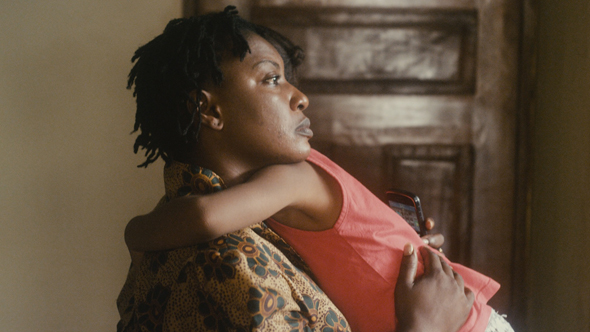
Synopsis: During her pregnancy Amaka (Nwadili) realises her unborn child has died. Desperate to give her husband a son she fakes the remaining months of the pregnancy, seeking out someone she can adopt from.

African dramas can often be shocking to a Western audience. A film like Accession brings in superstition without irony that’s hard to believe, and a rape scene too explicit for most. B for Boy is not as extreme as to bring in a plot thread as worrisome as Accession’s, yet it does explore the polygamous nature of some African marriages. It’s easy to imagine that in every culture the in-laws can be difficult; far from the comic nature of this is the tense scenario that Amaka’s mother-in-law will bring another woman to her household as another option for her son.

Distraught as Amaka may be for losing her unborn child, the continuous meddling from her husband’s mother piles on the drama. There seems to be no peace for the protagonist, and moments of pure serenity are hard to find. As the film is a slow-burner, there still remains nail-biting dread in the form of the 9 month pregnancy – a ticking time bomb for Amaka who must give her husband a son.

Needing to birth a son, the miscarriage is not the only crisis itching away at the main character. Uche Nwadili does a wonderful job at portraying this tragic figure who not only cannot spawn a son, but cannot give her husband a baby whatsoever. Amaka is a strong woman, intent on doing right for her and her family, whatever the cost. Nwadili becomes this woman, nursing sad eyes yet with body language urging her resilience.

The remaining cast are largely overshadowed by Nwadili’s efforts, apart from Joy (Okeke) who appears more desperate than Amaka. It’s a tight cast for a small story, easy to follow and to observe the cracks appearing in the handful of relationships. As a domestic drama it’s a nearly universal story, though some aspects allude to a very specific African lifestyle that limits its audience.

***

Also posted on LiveForFilms

57th LFF Review: Late at Night - Voices of Ordinary Madness


Director: Xiaolu Guo

Synopsis: A documentary on a select few of East Londoners talking about their lives and their feelings on the UK’s capital.

Experimental in sections, Late at Night is an grating film mired with an uneasy tone. Crossing between a fake newsfeed of past news stories and interviews on the East End streets, the film is relatively recognisable with its form. However, the newsfeed is presented in a Warhol-esque collage, plastered with quotes from famous philosophisers. With a barrage of information it does work at reflecting the drip-feed of contemporary news, although it’s unavoidably jarring.

The actual interviews are short and frequent, some damning of the city, others kind to what it offers. In 9 out of 10 of the interviews, all interviewees work and live in poor areas. Rather than seeking sympathy, the majority of these interviewees protest the systems of the nation. It’s rather depressing to hear story after story of damnation, even more distressing to hear the report of an act of violence.

On occasion the film reminds of the danger on the streets of our country, with people too angry and naive to behave neighbourly. Along with testimonies from some agitated citizens (one of which felt the need to strangle someone), the “newsfeed” churning out reminders of the London riots, gang wars and petty criminals, it leaves you feeling nothing but scared and sad.

**
Also posted on LiveForFilms

57th LFF Review: Weekend of a Champion


Directors: Frank Simon, Roman Polanski

Synopsis: An intimate look at Jackie Stewart’s weekend at the 1971 Monaco Grand Prix – now with an extended one-on-one interview between Jackie Stewart and Roman Polanski.

A tough sell for any one not interested in motor racing or Roman Polanski, Weekend of a Champion just seems like a fly-on-the-wall documentary following one major racer – Jackie Stewart. Nevertheless, only the most cynical will see nothing past the subject focus; for anyone else, this is a fantastic insight into a person’s career.

Only running at 93 minutes (with at least 20 minutes devoted to Stewart and Polanski’s recent discussion on the film), the film is not too taxing for those perhaps not familiar or intrigued by the focal point. However much or little appeal you have for Formula One, this documentary succeeds in not exploring the sport in general, but just one man’s abilities. Stewart, followed by Frank Simon and Polanski’s camera, is generously open as the filmmakers record his every utterance and movement. Relaxed by the years of celebrity, Stewart speaks his mind (poles apart from the contemporary stars wary of the reporter), never shying away.

Stewart’s confidence around the camera leaves us with a dynamic commentary as he explains how he goes about racing. One scene has us planted in the passenger seat of Stewart’s car, leisurely taking us through the track and his machinations. Explaining the gear changes, the shape of the road, the tyre traction (and even more manoeuvres) may sound tiresome to the non-F1 crowd, racing-specific as it is. Nothing could be further from the truth though – understanding what makes a person the best at what they do, whatever the discipline, has enormous merit.

Other scenes continue in this vein, whilst some merely show Stewart chitchatting with friends and colleagues. It begins strongly with the run-through of the track, and ends with a terrific run-through of the documentary itself. Roman Polanski and Jackie Stewart are shown sitting in the same room of the same Monaco hotel, reviewing what they’ve just watched and also their lives. Time has given both men mature and impressive ruminations on not only the film but how they’ve lived. It’s engaging to see two brilliant minds casually discussing a larger-than-life existence.

By the end, you are educated on a specific expertise, the culture of the 1970s and, to finish, two men’s exceptional lives. The restored Weekend of a Champion is much more than a F1 film; it’s a rewarding study of professionals in their respective fields.

****

Also posted on LiveForFilms