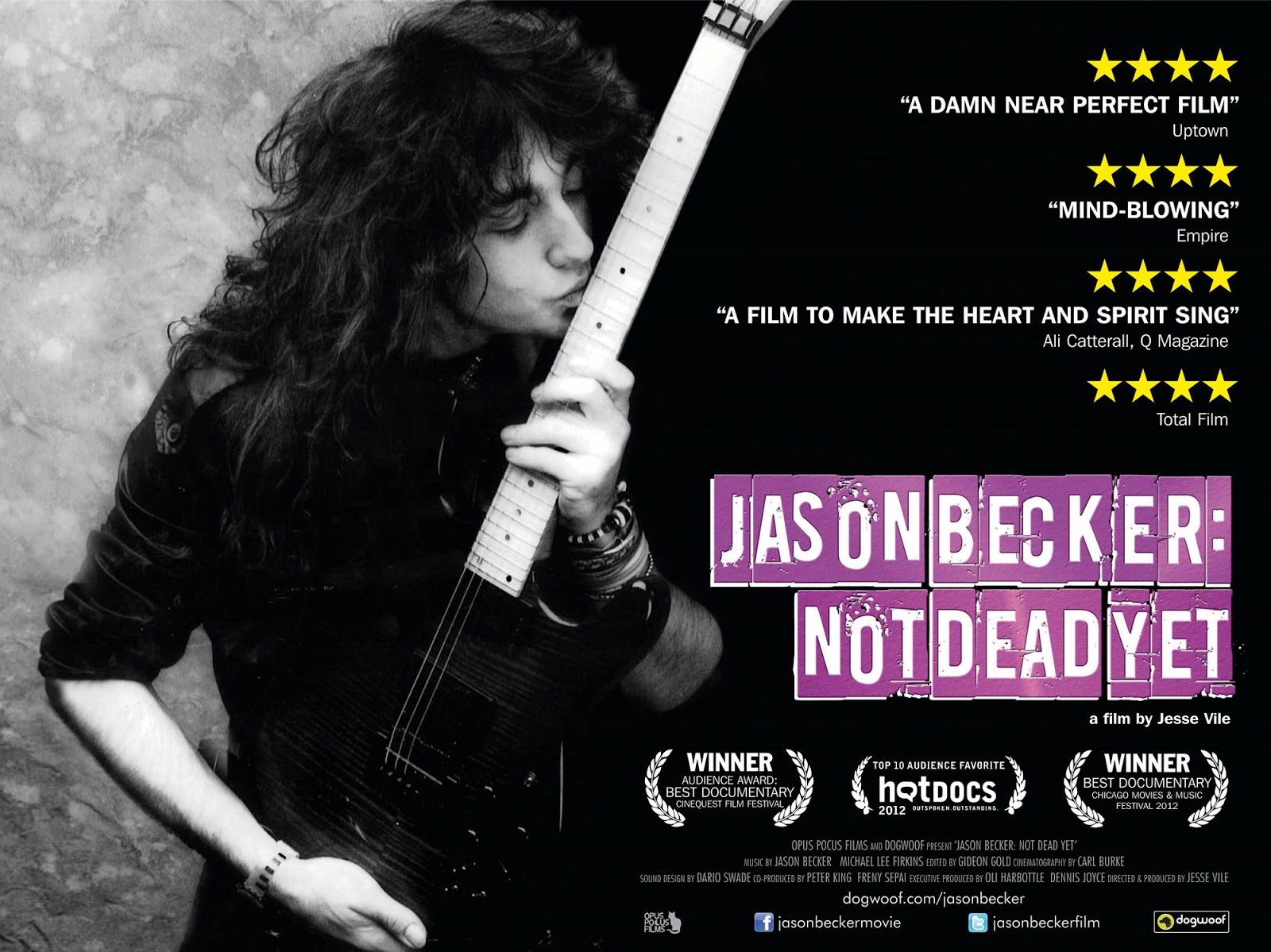
Jesse Vile: I first heard out about Jason when I was a teenager, and I was
taking guitar lessons and a guitar teacher of mine told me about Jason and gave
me some of his music and I immediately fell in love with it. Then when I read
more about his story and heard more about him I just became more and more
interested in him as a musician and as a person. And so over the years [I] just
loved his story and wanted other people to know about it.
I would always try and introduce
people to his music and show them songs and things like that and tell them, and
they’d always go, “Wow, that’s amazing!” And I just wanted to do that visually
and I have been involved in film for many years – I studied film – and so,
naturally, making a film about him was the next step.
PM: You’re producer of the Raindance
Film Festival, which specialises in promoting new filmmakers, how long were you
part of that?
JV: Well I was. I was from 2006-2008.
PM: When did you start prepping for Jason Becker: Not Dead Yet?
JV: It was under 2 years. Essentially I’ve been in the film
industry for 10 years or but it was always in the position of helping other
filmmakers and I wasn’t doing my own work and I went to film school, I want to
be a director, and so I don’t want to take a back seat. I was at a point in my
life where I decided I was going to make my own dreams hopefully come true, so
that’s what really launched it. And I saw a lot of filmmakers, who I met, and I
saw their work, and I saw that it was doing really well and I thought, “Well,
I’ve met them and they’re not any smarter or more creative than I am; I’m sure
I could do something just as good, if not better.” That’s the attitude you have
to have in life – just go and try and do it. So, yeah, it was under two years.

PM: How was it going about the process of making it? How easy was
it to get Jason and his family involved, and to collate all that footage and
material?
JV: We spent a good three or four months just taking on the phone
and on email. I sent them over a ton of questions and they’d send them back and
I’d just always ask questions and try and get a better understanding of who
they were as people; where they fit into the story, where everyone else fit
into the story and then take it from there.
They’ve been a part of the
process from the beginning all the way until the very end. It was very
important to have them involved for many reasons. Mainly, because I thought it
would make a better film. So anything from giving me their archive—their
footage of Jason as a kid, as a teenager, photos, any audio, any scrap of
anything I wanted. So they had to dig everything out (they hadn’t done that in
years) but it’s good because I digitally archived everything and gave them a
copy. So now they copies of everything saved on DVD and stuff.
PM: There’s a scene in the last third of the film where Jason and
his dad are communicating through the sign language...
JV: They call it “vocal-eyes”
PM: Well when we see them using the “vocal-eyes” technique, it all
seems second-nature to them and very interesting to watch, was there any
thought about extending stuff like that? With all that footage you mention, how
did you decide on a particular length/structure?
JV: Well we went through various cuts and various versions of the
film and the final film was the one that we were the happiest with; we felt it
was the best film we could make. We initially discussed having a more
past/present, present/past in the way we told the story – mixing up the way we
told the story/the form – but I was just always more interested in the classic three-act
structure. Mainly, with the first two acts being a telling of Jason’s story in
a linear fashion, and the third being the present day – that’s just the way I
envisioned it and when you wrote it down and laid it out that’s, I think, the
easiest way to digest the story and it also helps to tell the best story.
PM: The pacing is handled expertly. And this is your first feature
film, is that right?
JV: Yeah.
PM: Well drawing upon that: the start of Jason’s story looks at his
musical education (Bob Dylan, for instance), what education did you bring to
the project? Did you watch a lot of documentaries before starting?
JV: I watched a ton of documentaries; I mean that’s all I watched.
I mostly watched biographical ones; just to get an idea of how other directors
did things – not to copy anything but to get a sense of how certain things are
done, or how certain things can be done. You watch anything that’ll educate you
or help you develop as a filmmaker. There were certainly ones I gravitated more
toward – it’s really the ones that were more honest and true, that captured the
spirit of the individual as that was more of what I was going for.
I would send Jason DVDs of
documentaries to watch also, as I don’t think he watched too many docs and I
think, at first, he was a little wary of opening up so much. My initial
conversations with him I think he was planning on putting on a front but not
revealing himself as much as I wanted him to. So without saying anything I sent
him documentaries like Tyson, in
which he [Mike Tyson] reveals a lot about himself (he even cries) and Anvil, which Jason was like, “Oh my God,
I hope you don’t make me look as ridiculous as those guys!”. But they’re honest
and open and they don’t hold anything back, so I sent him those films (and a
few more) just so he could see that to make a good documentary it’s really
great when people are honest and open.
So I watched a ton of documentaries and I read Jean-Dominique Bauby’s The Diving Bell and the Butterfly. I had
seen the film a couple of times before I started making this film but I wanted
to read the book and get a sense of what it’s like to be trapped inside your
body. So I definitely read and watched a lot.
PM: Sadly, the success of The Diving Bell and the Butterfly is
something Bauby was not able to experience; this isn’t a nice thing to bring up
but the fact that Jason’s disease is terminal, did that dread affect you as you
were making the film?
JV: It didn’t in terms of making me
feel weird or anything, but because it’s so up in the air (his life expectancy),
no one really knows – it’s unprecedented. So I was always panicked that we
weren’t going to finish it or that he was going to pass away before we had
chance to finish it. Not for any other reason than I wanted him to see it and
experience any kind of publicity or fan-fare that he would get from it, and so
thank God that that didn’t happen. That’s probably the only time I ever really
thought about his terminal illness. Because every day is a miracle for him; I
was like “Wow, it’s almost three years—three and a half, that’s a lot of
miracles.” So thankfully he’s still around.

PM: Well it is a miraculous story and
it has the chance of reaching a massive audience because of that story of a
strong human spirit. What are your expectations of the film?
JV: Thanks, and I know what you mean,
but unfortunately documentaries aren’t the most popular form so it really just
depends on cinemas picking it up and putting it out there, getting it into the
press or just something happening (it being on a famous talk show). There’s a
lot of great films that don’t get seen by as many people as they should, so I
don’t know. I just hope it helps Jason and his family and that people take away
something positive from the experience of watching it.
PM: Well documentaries are kind of
thriving at the minute, so has there been any push from distributors?
JV: Yeah, well we have UK distribution,
US and Canadian distribution and hopefully they’re doing their jobs in trying
to get word out as much as they can, and having the film into as many outlets
as they can. But they can’t control the cinemas – if the cinemas don’t want to
book it, for instance. But we have a Facebook page with 40,000+
strong around the world. And Jason has a huge following. So we just promote
every screening and try to get as many people as we can to go, and try to do as
many interviews as we can, and that’s essentially all we can do. I’m a
one-man-team – doing all this stuff on my end and there’s only so much I can
do. But hopefully it gets out there.
PM: Well I imagine anyone who’s seen it
so far – me included – hopes the same.
You mentioned
being on your own for the promotional side of things but when it came to making
the documentary how did you assemble your crew?
JV: Most of them were NFT [National
Film and Television School] graduates and so what’s really good about NFT grads
is that they’re usually very talented, very creative, and they’re looking for
projects; they’re fresh out of film school with all this knowledge and talent and
looking for big projects. So I asked one of my co-producers, Peter King, if he
knew anyone and he’s worked with some people and he gave me a few
recommendations - that’s how I found my sound designer and my cameraman. With
my editor I was just asking people – I asked my sound designer for any
recommendations he had (people he knew, people he’d worked with) and he gave me
a few names and then I went to an editing talent agency – I can’t even remember
how I got the other guys – to interview them and the one I gelled with the
most, and the one I felt the best energy from, and whose work I liked the most
was who I went with.
It was a small
budget – they weren’t doing it for free but compared to what the top editors
earn it was very little. It was really just getting recommendations from people
and meeting them and making sure their ideas for the film gelled with mine and
that I got a good feeling from them.
PM: Did their love for music come into
that choice at all?
JV: I think originally – it definitely
helps if they like music (none of them liked Jason’s music to begin with) – I
was looking for an editor who was a shred guitar fan; I felt I needed someone
who knew what that type of music was about and just got it. But then that
didn’t happen (it didn’t break my heart that it didn’t happen – I wasn’t
beholden to that idea) and after I picked my editor I realised it’s actually
better they’re not into that kind of music because I wasn’t making the film for
fans or fans of shredded guitar, I was making it for people that don’t even
know about it but will still like the film. So I thought it was more important
to have someone who was into music, but not into that type of music because then you would have had a fan-boy
putting in lots of stuff, and as a director I would have stopped them, but it
would gotten in the way of things. The main thing was that they were all in
love with Jason’s story and that was important. Everyone who worked on it was
very passionate about Jason’s story and that was the important thing with
putting it together. This wasn’t a money project; it was more about getting
experience (of course getting paid, too) and believing in the story.
PM: Speaking of music, what’s your
favourite track of Jason’s? It’s incredible that even after being diagnosed and
becoming paralysed that he still writes music – are you a fan of the new stuff
or more taken with the old classics?
JV: Well I like everything that he’s
doing, but my favourite stuff is the stuff that turned me on to him because
it’s nostalgic and it’s what launched this whole thing for me. My favourite
track (which is probably pretty much everyone’s) is “Altitudes” which is on his
first solo album, Perpetual Burn –
that’s what made me stop and say, “Wow, I can’t believe this 17 year-old is
exuding this much emotion in their music with the guitar” and that’s what made
Jason stand out for me, so for those reasons I prefer his early work.
PM: I know you mentioned it not being a
money project but would you release the soundtrack for the film?
JV: I don’t think so because I know
nothing about the music industry and, again, it’s just me and I don’t have the
time or resources to put out the soundtrack and I don’t think his record label
does either.
PM: But it’s all out there anyway?
JV: Yeah, the only thing you can’t get
is the original score that Michael Lee Firkins did, which is not throughout the
whole film (it’s mainly in the first half of the film – it doesn’t appear at all
in the third act).
Actually, there
are two tracks in the film that you can’t get yet but I’m sure they’ll be out
soon.
PM: Right at the end we see that
concert honouring Jason – is that more common now? Are people more aware of the
man behind the music thanks to the documentary?
JV: I’m not sure how it’s affected his
album sales but he’s going to a lot more screenings and he’s a lot more active
now because of the film so that’s been really great for him. It gives him stuff
to look forward to and to go out with his family and friends, celebrate his
life and meet new people – in that regard it’s been really great for him.

PM: Veering off from the film, have you got any future projects
lined up?
JV: Yeah, I’m developing one at the moment. It’s way too early to
get into it – I’m not supposed to say anything about it – but it’s the early
stages of development. It’s quite a complex story but hopefully it does happen.
Thanks to Jesse
Vile for taking the time to take part in this interview and to DogWoof Productions
for setting it all up.
Jason Becker: Not Dead Yet has a limited
release starting from the 16th November, you can read the review for
the film here.