Friday, 4 January 2013

Berberian Sound Studio Review


Director/Writer: Peter Strickland

Starring: Toby Jones, Cosimo Fusco, Tonia Sotiropoulou, Susanna Cappaellaro, Layla Amir, Eugenia Caruso, Antonio Mancino

Synopsis: Gilderoy (Jones), a sound engineer for a UK television and film industry is mysteriously hired to work on a psychological thriller in Italy. There in the Berberian Sound Studio Gilderoy’s mind starts to slip and he becomes more involved in the production.


The effect of sound in a horror film is, quite often, the determining factor in the movie’s ability to frighten you. The experience of Berberian Sound Studio is electrifying in its manipulation of sound and the resulting psychological outcome. It does not play on the tried conventions of violin shrieks or symbols clashing to have you jumping out of your seat. Instead, director Peter Strickland takes the audience through a very introspective analysis of sound effects and the jarring nature of their engineering.

Toby Jones’ Gilderoy, a mild-mannered, quiet sound-mixer, is the perfect figure to magnify the horror that emerges around him. Having a reserved protagonist secures empathy with a wide audience whilst making the events around the “average Joe” appear distressingly chaotic. As Gilderoy becomes an intrinsic part of the diegetic film’s creation, it is understandable to see how his daily intake of what we imagine to be distressing content haunts him to no end. Strickland never shows the audience the “Equestrian Vortex” film that Gilderoy is working on but one can gather that from the sounds and descriptions we hear, it is very traumatic. Jones does a terrific job at playing the various levels of distress that Gilderoy undergoes. The perky, slightly confused employee at the start soon evolves into a tired, jittery wreck – all masterfully expressed by the British character actor.

As Jones has mostly been seen in bit-parts and numerous supporting roles it is refreshing to see him at the forefront of a film (also note Infamous and the upcoming Hitchcock film, The Girl for Jones in the lead). His supporting cast are relatively unknown though all provide Gilderoy with enough foils, love interests and collaborators to make his experience in the Berberian Sound Studio all the more interesting.

As Gilderoy first walks through the bland-coloured corridors of the studio, echoes of a woman’s screams fill the ether – it is the beginning of wanting to find out more about this place as well as providing the film with an immediate omen of dread. Out of all the film’s triumphs it is the sound that is most impressive. Now on DVD/Blu-ray, the purchase or renting of Berberian Sound Studio deserves a surround sound system to enhance all the nuances of the film’s glorious noise. As much as the story itself stays with after the film ends, it is the notion of sound and volume that keeps Berberian Sound Studio in your mind long after you’ve finished watching it.

Strickland’s clear knowledge of the genre, along with particular muses (Lynch and Argento), gives the film a perfect pace, well-crafted characters and a captivating narrative. Harking back to the analogue engineering of sound effects, the 70s movie enterprise is lovingly recreated by Strickland and his set design team, adding to the feel of authenticity in the film. It is not the average slasher/paranormal/exorcism horror that regularly litters the cinemas, but a brilliant psychological voyage into sound and stress. 

****
By Piers McCarthy. Also posted on Flickering Myth.

Top 10 Films of 2012

Clue's in the title.

10. After Lucia
A frank, gut-wrenching look at bullying. Some may criticise After Lucia for it knowingly tugging at your heart strings and using a few clichés primed for plot development. Nevertheless, events that transpire in the narrative are unforgettably upsetting and hard to watch, resulting in a powerful film. Alejandra, played with tremendous poise by Tessa La, is a modern tragic figure to a very believable extent. How Alejandra’s story, the bullies’ and Alejandra’s father’s arcs meet is one of the best thread closures of recent cinema. 

Read After Lucia's review here

9. Hara-kiri: Death of a Samurai

Elegant, classic filmmaking perfectly on show in Takashi Miike’s latest. Partially showing two sides to a story (a-la Rashomon), Hari-kiri focuses on two samurai suicides and the reasons behind each. Shot with magnificent depth in sets wonderfully constructed, it is a beautiful film to behold. Performances, especially Ebizo Ichikawa, are phenomenal, bringing about a poignancy rarely witnessed in mainstream cinema. 


8. End of Watch


Cop dramas are a dime a dozen though when one comes along that is critically successful it is worth taking note. The likes of The Untouchables, L.A Confidential and Heat rank among the best of the genre though End of Watch could easily stand alongside them. Occasionally the camera work and representation of the villains desires scrutiny though it is the relationship between Jake Gyllenhaal’s Brian and Michael Peña’s Mike that awards the film it’s acclaim. 

Read End of Watch's review here.
7. Argo


Ben Affleck’s hat trick in directing has been completed with his latest, Argo. The unbelievable yet true story about the escape of American hostages in Iran after a coup d’état is thoroughly gripping. As well as being a taut thriller (the finale promoting Affleck’s undeniable skill calling the shots), Argo has wicked moments of humour amongst the drama that makes it a highly entertaining film. Another mention in this list – Scoot McNairy, whose part in this film often steals the limelight. 

Read Argo's review here
6. Killing Them Softly
 
Andrew Dominik’s cold, satirical and biting image of Obama’s America didn’t fair well in the US for obvious reasons but it does not detract from its overall success. Artistically it’s sublime, with music and cinematography creating a compelling atmosphere. Pivotal scenes will not go unforgotten – brutal yet beautiful set pieces to punctuate scenes of heavy (though brilliant) dialogue.
Featuring two up and coming stars, Scoot McNairy and (slightly more known) Ben Mendelsohn, alongside heavy weights such as Brad Pitt, James Gandolfini, Richard Jenkins and Ray Liotta. From Pitt producing to his re-teaming with Dominik, you can tell that this a passionate project of their's, which never fails to shine through. 

5. Martha Marcy May Marlene

An indie hit at festivals, Martha Marcy May Marlene is a memorable, chilling portrayal of a cult. Less stylistic than The Master that similarly dealt with such topics, but arguably a better film. The direction, writing and acting are are wondrous (notably Olson and the fantastic John Hawkes), leaving you thinking about the film months after you've seen it. 

4. Liberal Arts


Second entry to feature Elizabeth Olson, highlighting how much of a new talent she is. A mature, sweet rom-com from writer/director/actor Josh Radnor. With a terrific supporting cast including the lovely Elizabeth Olson, Richard Jenkins, Allison Janney and a surprisingly good performance from Zac Efron. Liberal Arts looks at the quandary of dating someone slightly younger than yourself and the moral implications of that. Played with expert wit and fused with charm and geniality, Liberal Arts was not only one of the best rom-coms of this year but of the last decade. 

Read Liberal Arts' review here

3. Polisse

A hidden gem of this year with only a limited release, Polisse is the film you have to seek out. Advertised as similar to The Wire, there’s not much that can detract from that comparison – Polisse is every bit as engaging, dramatic and educational as the seminal HBO series. Based around the lives of a child protection unit, Polisse is often disturbing but never fails to provoke emotion. It’s not often that a film could do with a TV spin-off but Polisse’s characters and narratives arcs are deserving of hours more exploration. A stunning portrait of the police and the difficulties of the job. 

2. Skyfall


Many comparisons have been made with Skyfall and Christopher Nolan and whilst this may irritate certain people, it is true that intelligent blockbusters have been helped by Nolan’s last 3 films. The latest Bond outing is a triumphant, mature cinematic treat. Helped by three great writers, the legendary cinematographer Roger Deakins, and sophisticated director Sam Mendes, Skyfall not only entertained but had consistent artistic merit.

Read Skyfall's review here
1. Untouchable

One of the greatest buddy movies of all time and certainly one of the funniest and touching films of of the last few decades. A simple (and true) story of a quadriplegic and his aid with more than one conflict of interest. Sounds relatively lacklustre but an opening set piece involving a car-chase, a jovial dance scene, a majestic skydiving moment and numerous incidents of top-class, hilarious quips between Francois Cluzet and Omar Sy make it very special. An absolute must-see.

Read Untouchable's review here
By Piers McCarthy. Also posted on LiveForFilms

Monday, 17 December 2012

The Hobbit: An Unexpected Journey Review


Director: Peter Jackson

Writers: Fran Walsh, Philippa Boyens, Peter Jackson, Guillermo Del Toro

Starring: Martin Freeman, Ian McKellen, Richard Armitage, Ian Holm, Elijah Wood, Hugo Weaving, Cate Blanchett, Andy Serkis, Christopher Lee, Sylvester McCoy, Barry Humphries, Lee Pace, Ken Stott, Graham McTavish, William Kircher, James Nesbitt

Synopsis: Biblo (Freeman) lives an ordinary life in Bagginton and then one day is asked by a friendly wizard Gandalf (McKellen) to accompany a group of dwarves on an adventure to reclaim treasure. 


The Lord of the Rings and The Hobbit have the obvious connotations of fantasy, yet there is also the notion of time attached to the works. All books took a considerable time to write (with J.R.R. Tolkien attempting numerous rewrites on The Hobbit) and the author was the grand age of 63 when his follow up to Bilbo's story, the trilogy on that "precious" ring, was published. When we think of the seminal novels, thoughts of long-winded description and hundreds-upon-hundreds of pages are not uncommon. In contemporary terms the stories are largely associated with Peter Jackson's epic adaptations - the saga that lasted from 2001 - 2003 and a further trilogy starting now in 2012 and finishing in 2014. Watching the adaptions thus far will take a hefty 727 minutes (and that's not counting the extended versions' run times), a time that could easily be matched by reading the books themselves, depending on your reading speed. There has, arguably, never been an adaption of a series of works that has gone beyond the full ten yards in order to engage the audience with that specific world. The Hobbit is no different; it is a grand spectacle filled with meaty action, vibrant aesthetics and stories and characters never to be forgotten (just remember to have a bathroom break before it begins).

For those not completely won over by the events of The Lord of the Rings, The Hobbit could equally disappoint. It is advertised as more frolicsome and funny than The Lord of the Rings but this is not always the case with the film. The beginning, which introduces Bilbo and the Dwarves, contains many amusing skits and songs but once the journey begins it recaptures the style of the now-classic trilogy. Swooping shots of the scenery along with Howard Shore's beautiful score are both help and hindrances to this new addition. In one sense, it reminds of you of how easy it is to fall in love with this world. However, these features also become overly-reminiscent of films past, sometimes distracting for when you need to be in the modern moment.

For the most part The Hobbit is boasting something very new. Not only does it focus on a story 60 years before the Fellowship was established, it enhances all of the technology once used to bring Middle-earth to life. Shot in 3D and 48fps (double the regular 24 frames per second to smooth out movement), The Hobbit is a dazzling new display of Tolkien's imagination. The mines, caves and shrubbery that makes up a large portion of the landscape is layered thanks to the 3D. What's more, the frame rate (that may go unnoticed by some) is quite astonishing at points. The handheld camera work that can often disorientate in films has a fluidity with the 48fps, perfected with the static shots. Both technologies together animate the action far beyond any previous cinematic means - purely immersive.

Even with an aesthetic that never fails to keep you wide-eyed, the film does have its moments of tedium. Just as The Lord of the Rings had scenes of dull exposition, The Hobbit is not without its moments of informative, though dreary, dialogue. With Jackson stretching out the 300 page book (give or take) to three films, the tried nature of this approach can sometimes seem blatant. The Rivendell sequence, for instance, reeks of some superfluousness. At times this added material lends itself well for characters, though can also spoil it. The appearance of Saruman should be a moment of sheer delight (especially given Sir Christopher Lee's fragile state) though he is mostly muted in preference of Gandalf and Galadriel's mind-messaging.

It is often the smaller roles within the film that garner more attention than the key players (Bilbo, Gandalf, Elrond and Galadriel). Sylvester McCoy as Radagast, Barry Humphries as the Great Goblin and Andy Serkis back as Gollum (known by many but with only a minor part in this trilogy) eat up their scenes with extremely pleasing results. All three characters have dialogue that could have easily made the remaining cast jealous - all playing larger-than-life roles in some pivotal scenes. With two played under the guise of a motion-capture suit it may be easy to dismiss their performance - or to forget the actors beneath the CGI - but the Great Goblin and Gollum are wonderfully, frighteningly real.

The final words of mention should go towards Martin Freeman taking the reigns of this entire film, and his accompanying Dwarves. Ian Holm's sweet, antiquated Bilbo was one of the many loveable side-characters of The Lord of the Rings - a brief part in The Hobbit's prologue sternly reminds you of his influence. It takes some time to get used to Bilbo as the lead as you may have forgotten the somewhat pedantic, obstinate ways of the Bag End resident. Freeman plays this with perfection, though it is easy to take this as a negative - the subtle grumpiness to the character does not make the most admirable hero. The charm that is an innate part of Ian Holm is yet to be discovered in Freeman (probably due to his age) and he is not always the idyllic leading man. It takes the entire film for Bilbo to emerge as the familiar hero figure - putting him in good stead for the following two films - making him a tad unlikeable and irritating throughout most of An Unexpected Journey.

Joining Bilbo on his quest is a pack of feral, boisterous Dwarves. Each has a unique personality (not all profiles fully illustrated so far) and make for a memorable movie mob. Focus is put on Richard Armitage as Thorin (leading man in the film's superb battle scenes), an skeptical warrior whose objective and blood-line comes first. He makes for an interesting foil to Bilbo in many segments, and an even better enemy of the Pale Orc Azog (a villain that brings a tremendous amount of ruckus). Much like the key-players, however, Thorin is not the most interesting of the Dwarves and the jovial Bofur (played by the ever-affable James Nesbitt) and "Doc" Dwarf Balin (Ken Stott) prove to be the best of the bunch. There is little fault in Freeman and Armitage's performances, it's mainly down to their character and their lack of experience at the forefront of a blockbuster.

Everyone will have their favourite Dwarf (if not by the end of The Hobbit, then certainly by its second sequel in 2014) and discussion will erupt over who should be seen as the chief character between Bilbo, Thorin and Gandalf when it comes to The Hobbit. Outside of the story there will be no question over the man in charge. It would have been intriguing and imaginably entertaining to see what Guillermo del Toro would have brought to his vision of the text, yet the man at the helm since 2001 is suitably standing in as director. Peter Jackson, who knows Middle-earth better than nearly anyone, lovingly restores the tokens of Tolkien with an exciting new cast, memorable alumni, an enchanting story and an awe-inspiring aesthetic. Some may have grown tired of this world but for those eager to get back to it, The Hobbit gives and sets up what every fan is itching for - adventure.

****
By Piers McCarthy. Also posted on Flickering Myth

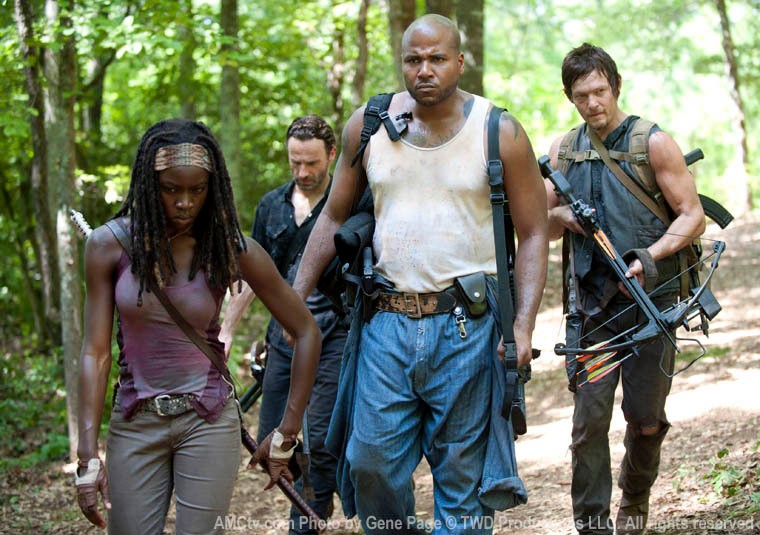
The Walking Dead Season 3 Episode 8 Review


Perhaps due to the massive build up, there was no way The Walking Dead’s mid-season finale could really knock your socks off. Furthermore, with it being mid-way through the season’s arc, there couldn’t have been too many threads opening out without the drama exploding somewhat superfluously. That is not to say that “Made to Suffer” isn’t a great episode, it is – just not in comparison to the rest of Season 3.

Major Spoilers Follow

The nail-biting end of episode 7 saw Rick, Daryl, Michonne and Oscar on the feral side of Woodbury’s fence. One query I had last week was whether Merle, the Governor and Andrea would head off to the prison and the two groups would miss one another by a mere few metres or minutes. Fortunately the tension is amped up when our heroes enter into the Woodbury community whilst the Governor and his band still plan from within their base. Maggie and Glenn are still being held prisoner and their fates (among many) hang in the balance.

The episode does not start where we left off but instead begins with a foggy shot of a wood with the accompanied sound of a high-pitched scream. We cut immediately into the wood to a group of survivors led by a burly black man (Tyreese played by The Wire actor Chad Coleman). As well as introducing new characters (mostly a bonus in this show) this epilogue contains some of the best prosthetic work so far. Recently CG has taken over some of the walker kills but as Tyreese hacks his way through the undead there is either invisible CG work at play, or just fantastic make-up effects. The scream came from an injured member of the party whilst another one is bitten as they run for any kind of cover. In their desperation to find shelter and a place to recuperate, they walk into the prison (open thanks to a split fence – how walkers have not got in this way so far is slightly befuddling); more stories intertwining for this finale.

A lot of attention is given to the Governor’s naive obsession with having walkers cured, the prime case being his daughter. She is locked in a cell in his warped room of death and trophies. There are moments where you can see desperation in his eyes (David Morrissey giving a terrific performance) as he yearns for some semblance of recognition from Penny. Even with this odd tragedy, the lengths he goes to try and control everything around him shows him to be narrow-minded through his need to bring back his old life. He is dangerous in this regard and Michonne is one of the only ones aware of this. Later when Michonne kills Penny (a moment of triumph; allowing Penny to be put to rest and a way to wound the all-too-powerful Governor) and subsequently stabs him in the eye, Andrea and maybe some viewers feel sorry for him. Despite this, he turns his loss and mutilation into a form of motivation – to strike out at Michonne and her new companions. The next half of the season will be doubly dramatic with the Governor out to destroy. It will also have Andrea sided quite firmly with the Governor as her stand-off with Michonne post-stabbing finally shows them divided.

As well as the Governor, the townspeople of Woodbury are put in jeopardy by Rick and co who are unaware of what kind of place it is. They have one clear goal and that is to find and rescue Glenn and Maggie. They do this stealthy (thanks to Rick and Daryl’s cunning and tactical nature) but not without an eventual retaliation. This is where the episode falters somewhat and most action is shakily shot. What’s more, the smoke grenades that cover Rick and his crew fogs most of what the audience can see. It’s all integral to the moment but one can’t help wonder if this event couldn’t have been played out in a less choppy way.


After rescuing Glenn and Maggie the former tells Daryl about Merle. Daryl’s want to see his brother is touching but as ardent fans of the Rambo-esque character will note, that interaction would change things perhaps drastically. Rick’s tact for negotiation and reason allows Daryl to momentarily forget about his brother and think of the situation at hand. It is a wonder that after Daryl is caught and brought in front of the hostile Woodburians that he can live up to his word- to “talk to him [and] work something out”. Daryl has evolved to a lucid, caring figure and as much as it pains me to see him in danger, there is hope that he can work his way out of trouble.
Rick is still not clear of trouble himself and even as the main hero (hopefully bound to survive because of this) he has deep-rooted flaws. A slight delusion including Shane walking up to him (only to be a random Woodbury soldier) shows that his mind is still not without its problems. Mind not completely in the moment also leads to Oscar getting shot and killed - another character entered into Rick and Daryl’s circle that sees his end. At least there is a possible replacement with one of Tyreese’s people.

Back in the prison Tyreese and his group are stuck in the boiler room with a load of zombies only to have Carl save them. As one of the new characters is bit Carl has to bring them all back to a safe cell, though has to lock them in fear of the bitten one coming back as a walker. Tyreese seems collected even under the circumstances and appreciates the space around him – more safe and secure than they’ve known for weeks. He’s bound to become a great new character (plus, as a Wire cast member, there’s no doubt in his acting ability).

There is a lot to absorb in the 40 minutes, arguably more events and overlapping than we’ve seen up until now. My main interest for the next 7 episodes is Daryl imprisoned in Woodbury and how he’ll hopefully get out. The argument that things happen too quickly for this episode may not be considered by some viewers as the action does play out in a realistic time (frantic and for good reason). Still, to my mind, I would have preferred the new characters to have been introduced in February’s episodes and to have all the focus on Rick, Daryl, etc, and the Woodbury lot. That way Oscar’s death wouldn’t have been skipped over so fast, Glenn and Maggie’s close execution may have seemed more dramatic and Daryl’s disappearance and capture could have been investigated (it would be interesting to see how they caught the agile and aggressive hillbilly). Apart from episode 6 this is the least entertaining episode yet, but still miles ahead of what other TV has to offer.

By Piers McCarthy. Also posted on Flickering Myth

Thursday, 6 December 2012

Life Of Pi Review


Director: Ang Lee

Writer: David Magee

Starring: Suraj Sharma, Irrfan Khan, Adil Hussain, Rafe Spall, Tabu, Gerard Depardieu, James Saito

Synopsis: Pi (Sharma) spent his childhood amongst the magic and majesty of his family’s zoo. He always wanted to feel close to the animals, especially the zoo’s Bengal Tiger, Richard Parker. However, as the zoo starts to lose money the family relocate to Canada, only to find themselves in a terrible storm on the way that destroys the ship and leaves only a few survivors – two being Pi and Richard Parker aboard a lifeboat.

Without special effects it is fair to say that Life of Pi would have been one of the unfilmable novels. Any attempt to capture the magic-realism, the human/animal barrier of communication or the eclectic earthly elements would have been feeble were it not for CGI. Those wondering if the CGI is too obvious, whether the 3D is distracting or the fantasy too elaborate needn’t worry; Ang Lee has brought Yann Martel’s book to life with precision.

Life of Pi deals heavily with the unknown and incomprehension – not your standard Hollywood motifs. Despite this, Lee brings his expertise on scenes of intimacy and spectacle making both a riveting Hollywood adventure film as well as a majestic meditation on the human condition and of relationships.

Bookmarked with a writer interviewing the eponymous (adult) Pi, the narrative criss-crosses between Pi’s young life and his older self recalling the disaster. With this structure there are occasional moments to catch your breath when the events on the lifeboat become increasingly dramatic. Presenting itself as a family film, Lee and screen-writer David Magee have structured the film as well as they could in order to dilute some of the peril. The book was, at times, incredibly morbid and dark (especially in the aftermath of the ship’s sinking) – not so appealing to the sprogs. With the film there is the opportunity for everyone to enjoy it (great pleasure will be taken with the meerkat scene, for one).

The first 40 minutes warrant a film of its own – Pi’s young life living in a zoo and exploring multiple religions in his pastime – adding soul to what will later turn into a story of struggle and survival. Once the cargo ship that holds Pi, his family, and his zoo, sinks into the abyss of the Pacific Ocean, the film transforms into an exhilarating epic. This is classical story-telling of some of the highest quality, with a visual palette that brings it beautifully to life.

The colour and clarity of the picture is remarkable, with an opening credit sequence that gives you only a hint at its overall splendour. The 3D that Pi’s publicity boasts helps the aesthetic enormously. Some segments in the first third make great use of the 3D but it is not until Pi and a partly-carnivorous crew become stranded at sea that the three-dimensional work comes into its own. Few films make correct use of the technology – Avatar and Hugo being two examples – and Lee has gone to great lengths to ensure his film becomes a leading example. The vast oceans that leave Pi and Bengal tiger Richard Parker striking figures in a sea of blue show the subterranean depth. Furthermore, the splashes of tides, raindrops or paddling drown the audience in the moment.

At the heart of this enchantment is the story of Pi and Richard Parker trapped together on a lifeboat. Depicting the ferocious animal believably has not been easy for the team behind the film and Richard Parker is mostly seen in CG form. Kudos to the special effects team, however, as the tiger’s 80% artificiality (some scenes included an actual tiger) is flawless. Resting the film on the shoulders of the scrawny teenager and striped feline is something very new. Fortunately, each character develops throughout the film and the relationship garners an amazing amount of empathy from the audience.

As Pi explains, this is an unbelievable story; the film’s success requires audiences to buy in to it accordingly. There should be little doubt in its ability to do this as every element draws you in. It is a tremendous story that has already been enjoyed by millions (to note a flaw in the film, the book obviously includes a lot more than the film possibly could) and now has an adaptation that has the winning styles and themes of Classical Hollywood. At points the film is a taxing – with plenty of religious allegories and moments centred on the dangers of hot-blooded animals and the harshest oceans – and may bore or frighten some viewers. Nevertheless, it is a heart-warming and thrilling film that epitomises the experience of the cinema and of great story-telling.

****
By Piers McCarthy. Also posted on LiveForFilms

The Walking Dead Season 3 Episode 7 Review

The end of The Walking Dead’s first half of Season 3 is soon approaching. It’s a depressing thought as the show fuels its 40-something run-time each week with more entertainment than most other programmes currently airing. Still, the cast and crew behind AMC’s zombie drama are leaving us fans begging for more. Had episode 7 been the last, the final moments would have you screaming out in irritation of the hiatus. Fortunately, the penultimate episode builds up to something bound-to-be-tremendous awaiting us next week.

Major spoilers follow

Starting with Glenn’s vicious interrogation, the first sequence of “When the Dead Come Knocking” highlights the tenacity of both Steven Yeun and Michael Rooker. The latter, especially, ferociously throws half a dozen punches squarely in Glenn’s face and then pulls his bayonet to the prisoner’s mouth. The sadistic nature of this may remind some of Rooker’s Henry in Henry: Portrait of a Serial Killer that brought Rooker to the attention of Hollywood. He plays the maniac well and for Glenn, Maggie (who can hear all of the commotion from the next room) and the audience, the levels of his cruelty are horribly ambiguous. Eventually, his anger of his desertion on the roof way back when leads him to leave Glenn in a similar situation – taped to the seat and having Merle throw a walker at him.


We know Glenn can handle himself but in his moment of escape he becomes an iconic badass à la Rick or Daryl. His scream of both victory over killing the walker, and of complete desolation and fear, is his shining moment so far in the series.

Michonne’s part in the series is becoming more integral, and she is the first of the characters in other narrative strands to link one to the other (Rick et al - Andrea – Woodbury). Now she has moved on from Woodbury and Andrea and has entered the prison after being saved by Carl and Rick. Her wounds made her faint beneath a shuffling crowd of walkers and her independence has once again been tarnished. From the highly subjective point of view of the audience, Michonne’s need to be in control is annoyingly making her out to be uncaring. She frowns at all those that help her in the prison (thanking Hershel for his aid but somewhat insincerely).

It is only when she sees the group embrace Carol after her return, along with the cradling of the baby, that Michonne “sees the light”, so to speak. We saw her affectionate and friendly towards Andrea so here’s hoping that that kind of relationships develops as she makes a home with Rick and his group. With only one episode remaining for 2012, the depleted numbers in the prison does need some extra members and so Michonne could easily become one of them.

On an expedition to locate Maggie and Glenn, after Michonne informs them of Merle’s kidnapping, Oscar and Michonne join the troop. Together they stand as a smart and powerful force. Nevertheless, a hoard of zombies is a dangerous situation and so they hold down the fort in a thought-to-be-abandoned cabin. The stench and sight of death is merely a trick for one man to stay undisturbed in his once cosy home. The man barks at the four intruders, with Michonne telling the others to keep him quiet as walkers claw at the walls and door. Taking matters into her own hands, she uses her trusty samurai blade and sticks it in his skull. The decision to throw the body out into the walkers is something that shocks Michonne but is understandably justified to save their own skins. Watching a body get torn apart by zombies is a guilty pleasure when watching something with the undead. In Dawn of the Dead and Shaun of the Dead a living, breathing civilian is picked apart before our eyes, with graphic gore. Perhaps it was too much for the network to handle but the dead man’s ripped limbs and mangled flesh is barely seen. The blood and guts still show but it’s not up to par with other examples in this genre (in the heat of that moment, though, perhaps it could have been seen as superfluous).


As Michonne, Rick, Oscar and Daryl move toward Woodbury, events taking place there involve the testing of the biters’ minds. A Mr. Coleman is dying of cancer and has volunteered himself for psychological tests with Milton. Coleman is asked to raise his hand to a series of questions, with a side of audio conditioning, and given the same questions once he’s turned.

The Governor’s need to control is less about wielding swords or firing bullets, but to have control over the people around him. Sometimes that requires violence but as we have seen with his zombie daughter, some of it requires the human touch. The aim to break the spell of the virus and the belief it may be possible is corrupting his and Milton’s mind. Milton even asked for the restraints to be taken off of the Mr. Coleman (biter-version) and is saved only thanks to Andrea’s common sense.

Towards the end of the episode everything taking place is beginning to merge together. Maggie is returned to Glenn’s arms but after her confession about Daryl and the others’ whereabouts. As the episode draws to a close, plans are made for the Governor and Merle to go the prison as Rick and his team find their way to Woodbury. On one side of the gate, Andrea walks past and looks at the high looming walls of tires and fence – on the opposing side, Rick and Daryl ponder over their way in. It is a spectacular final few minutes, with the crossing over of stories finally being executed. As said, had this been the end of the season half, the wait would have been unbearable. One more week and Merle and Daryl may be reunited, Rick may come face to face with the Governor, Michonne will see Andrea again, and Woodbury or the prison (or both) will be infiltrated.

By Piers McCarthy. Also posted on Flickering Myth

Wednesday, 28 November 2012

Air Doll Review


Director/Writer: Hirokazu Koreeda

Starring: Doona Bae, Arata, Itsuji Itao, Jo Odeagiri, Sumiko Fuji

Synopsis: A life-size sex doll, Nozomi (Bae), comes to life one day and, after educating herself on her community, starts to develop and soul and heart.

Stories on the subject of sex dolls are seldom explored in cinema. Often times, the preferred manner of looking at sex dolls and their owners are through a darkly comic eye. Lars and the Real Girl mixed sentimentalism, drama and comedy together in its exploration of it and similarly, Hirokazu Koreeda’s Air Doll does the same. Where the Western film with Ryan Gosling and the Donna Bae-led Japanese film differ most is the animation of the doll. Whereas Lars and the Real Girl looked at the purchaser’s state of mind when it came to buying the lifeless thing, Air Doll brings that thing to life in order to reflect on what it means to be human.


Donna Bae as the eponymous doll does a fantastic job at mapping out the evolution of the human mind. She begins “life” with the mentality of a toddler, where curiosity reigns supreme in her outlook on life. She then slowly experiences flourishes of hormones in lust and eventually matures with feelings of grievance, love and gregariousness. The story lends itself to showing the change in her life but it is mostly Bae’s appearance that highlights growth. As she awakes from her plastic, inert state her eyes are wide and unblinking, absorbing the details of life. Slowly, through real-life experiences, the eyelids droop slightly and one or two lines appear on her shiny, immaculate face. The movements of the youngster’s zeal gradually become more restrained and the doll seems like any other civilian. As you have to invest your belief in this story, Bae manages to contribute a lot to its believability.

Problems do occur, however, with how you perceive the mysticism. Fairytales are, of course, fantastical but many show the line between reality and magic. For some stories it may be matters of one character seeing a different, unbelievable event take place whilst those around them are blind to any change. In Air Doll it is difficult to understand the metamorphosis of “reality” to accommodate the living, breathing doll. You could go so far to see the whole film as a figment of the doll’s imagination or maybe even one of the other characters’. In any case, some may struggle with the notion of magic in this film, especially considering its blend with social drama.

Trying to encompass all of the themes is something that detracts from the entertaining factor of Air Doll; had the film been cut down to 90 minutes it would make for a purely enjoyable film. There are several side characters that add more to Nozomi’s perception of urban life, all of them given decent characterisation, and mostly the right amount of screen-time. What’s impressive about the enveloping stories is that even with the slightly too-long runtime the end draws it all together in a beautifully shot montage.

Air Doll is a surreal take on the fairytale model with Nuances of Ozu and Capra. It fuses magic-realism better than most efforts and contains some great humour along with deep reflections on life and love. Certainly not for everyone; for those thinking it’s a light-hearted modern fairytale be warned, it contains frequent adult content.

***
By Piers McCarthy. Also posted on Flickering Myth