Showing posts with label Film. Show all posts

Wednesday, 21 August 2013

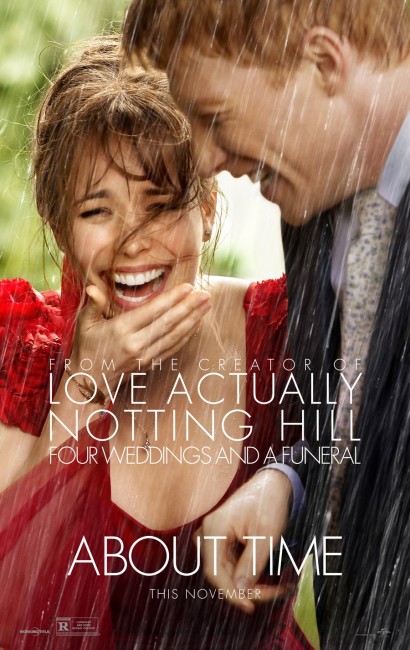
About Time Review


Director/Writer: Richard Curtis

Starring: Domhnall Gleeson, Rachel McAdams, Bill Nighy, Lydia Wilson, Tom Hollander, Lindsay Duncan

Synopsis: Tim (Gleeson), a quiet, timid 21 year-old lives a mundane life with the notable lack of a girlfriend. Things begin to take shape once his father (Nighy) reveals the family men are able to travel through time. Tim quickly uses his inherited power to discover more about life and, most importantly, to find love.

Richard Curtis has long since departed from snappy satire in the form of Not the Nine O’Clock News and Blackadder; now associated with strings of soppy romantic comedies. Yet, whilst his seminal television work feels like a distant, beloved memory for some, there are others more than happy with his Four Weddings, Notting Hills and Love Actuallys. He has an honest and indefatigable passion for the theme of love that, for the ones who pine to see and feel it, makes for some entertaining films. About Time, his latest rumination on love – with added time travel to mix it up a bit – is quite wonderful. Whatever flaws the film holds are, in the end, nearly forgotten thanks to Gleeson, McAdams and Nighy and a touching exploration of a father/son relationship.

Domhnall Gleeson as the protagonist Tim makes a strong debut in this genre – much like Hugh Grant did way back in 1994 with Four Weddings and a Funeral. Without a hint of his thick Dublin accent, Gleeson embodies the bumbling, shy Brit character perfectly. An everyman in his appearance and personality, he quickly establishes a familiarity with the audience. The same can be said for the film’s opening – a brief introduction of the Lake family. Here Gleeson and Curtis’ script portray the normality that makes the English rom-coms so accessible from the get-go.

With the pleasant English countryside and genial family members spotlighted the film then moves on to its hidden card in its cuff – the main character’s power to travel through time. Time travel has been continually tricky to pull off effectively in film and television and for About Time the errors and ellipsis still remain. However, Curtis has ignored some rules and added some of his own – the apparent lack of the Butterfly Effect but with certain restrictions concerning genetics. As Tim so often states, his abilities are often left by the way side in favour of living in life’s moments. About Time merely uses the time travel element to highlight the importance of “now”. When Tim flashes back and forth through his life it’s generally interesting and enjoyable but most appealing is his damnation of re-living events and focusing on the unknown future and a second-by-second existence.

With a strong core message the film is genuinely uplifting. Its other agreeable quality is the band of main actors. Gleeson is, as mentioned, a great screen presence with an innate charm and wit (aided by Curtis’ own pen). To know nothing about Gleeson and McAdams and to see only them holding hands would be tough to imagine; not that certain people can’t be matched but they do appear leagues apart. Original casting had Zooey Deschanel as his love interest – a choice that whilst agreeable would not hold a candle to Rachel McAdams. McAdams is one of the most divine women of contemporary cinema – down-to-earth and gorgeous. Nevertheless, personality and voice blend tremendously together and there is never a moment where you question their pairing. Third billing goes to Nighy as Tim’s father. He initiates the narrative by telling Tim about his gift – a scene that should be laughable and unbelievable neatly written and acted. Nighy is Curtis' lucky rabbit's foot, continually adding worth to each film he's written into. Whereas you'd expect McAdams to generate the film's emotion, it's actually Nighy who earns that role, brilliantly molding the film from behind the curtain more or less.

As much as McAdams lights up the screen, the film shifts from her focus to that of Nighy and Lydia Wilson’s tragic sister. This switch happens two thirds of the way through, turning the film from a romantic comedy into a heartfelt drama. Some may dislike the jarring change though they may be the ones not completely invested in the humanity of the story. Tim and his father share a bond commonly seen in families, with the added time travel skill that draws them closer together; sharing that much they have a beautifully strong relationship. By the end when time travel starts to prove difficult Tim spends more time with his knowledgeable Dad, there is a narrative crux that triumphantly brings tears to the audiences’ eyes*.

The beauty of family, life and love are profoundly explored in some of About Time’s runtime. The fun time travelling element may not be used as regularly in some viewers’ opinions though to see beyond that is the film’s most precious attribute. It’s heart-warming and smooshy, sure, but it’s also poignant and sincere. Most definitely the year’s best romantic comedy and (if it’s to be believed) a delightful directorial sign-off for Curtis.

****
  
*There weren’t many dry eyes in the screening I went to
Also posted on LiveForFilms

Thursday, 2 May 2013

Chimpanzee Review


Directors: Alastair Fothergill, Mark Linfield

Writers: Alastair Fothergill, Mark Linfield, Don Hahn

Synopsis: Disneynature’s new documentary follows the life of an energetic yet vulnerable young chimp, Oscar, living deep within the Taï rainforest.

Introducing children to the natural world may be a daunting prospect for a parent – it’s full of copious mating, fights to the death, and often nightmarish imagery. Whilst David Attenborough’s seminal series of wildlife documentaries are not to be missed, they are not always toddler-friendly. In response to this Disney have created a new independent film label – Disneynature – to show the twee aspects of animal life, as well as some of the perils.

Being a Disney product, Chimpanzee is decorated with many darling elements, such as bouncy music, funny recordings of animals falling or hitting one another, and scenes of tenderness. As well as this, they also introduce a narrative not-so-dissimilar to their animal-led classics such as The Lion King, The Fox and the Hound and The Jungle Book, with villains roaming and danger lurking. Showing a story unravel, and having characters and a “plot” to follow will inevitably make this easier for the little ‘uns; it promotes the basics of story-telling and simplistic ethics – “acts of evil and good appear like this, or like this”.

The story of the chimpanzee protagonist, Oscar, was supposed to follow his early life with his mother and nothing much more. However, mid-way through the shoot Oscar’s mother sadly died and the filmmakers recorded something miraculous happens – his adoption by the alpha-male of the group. This is Disney’s serendipitous injection of joy and hope into the film and it works wonders. Unfortunately, this event happens very late in the movie and the focus on it is not that extensive. There are a few moments where Oscar learns different tricks of the trade, and these suffice as fillers to a quite average chronicle.

We also continually crossover to the villainous chimp tribe, led by Scar (another discernible Disney reference), who, when coming into contact with Oscar’s family, can never be told apart. Without the forbidding score and occasional displays of rage, there is a lack of tension. Perhaps it’s diluted due to the documentary’s demographic but it’s certainly short of the drama in their fictitious films. Having some disequilibrium is required and welcomed, though better execution of such scenes could have improved the momentum.

Overall, it runs for the correct amount of time, especially with regard to the kids’ attention-span. For the adults it impresses with some often astounding cinematography (centred on the landscape and wildlife rather than the chimps) and the odd funny quip from narrator Tim Allen. It’s a loving portrait of an innocent animal and a relatively-new side to Disney that leaves their next venture, Bears, something to look forward to.

***

By Piers McCarthy. Also posted on Flickering Myth

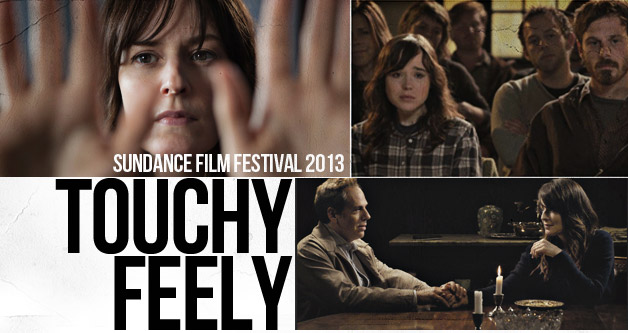
Sundance London 2013: Touchy Feely Review


Director/Writer: Lynn Shelton

Starring: Rosemarie DeWitt, Ellen Page, Josh Pais, Scoot McNairy, Alison Janney, Ron Livingston

Synopsis: When a massage therapist suddenly finds herself repulsed by human skin, she finds her romantic relationship and work-life in ruins. Meanwhile, her brother, a dentist, undergoes a life-altering bout of success in his practice. Crossing back and forth between the stories, Touchy Feely explores the subjects of interaction and progression.

Lynn Shelton’s canny ability to write and visualise awkward human interaction has given her a string of critical successes. Humpday and Your Sister’s Sister were excellent character-pieces, lovingly crafted with humour and heart; it then becomes a disappointment to find her latest, Touchy Feely, plain dull.

Scratch beneath the surface of Touchy Feely and there is a rich set of themes (humanity’s obsession with contact, desire and repulsion, and the idea of spirituality or intuition). Sadly, these are ideas too profound to explore in an 80 minute comedy/drama and Shelton’s attempt to investigate drains the film of life.

It’s a film packed with too many characters, motifs and story arcs – having a damning effect on the wonderful cast. All graciously at ease with their minor characters, it appears none of the fine character actors employed for the film saw an issue with screen-time. Contemporary favourites such as Alison Janney, Ron Livingston and Scoot McNairy have all-too brief moments (especially Livingston) but fail to make an impression. If you see any of the other cast in different films, you (usually) walk away adamant to seek out more of their work. McNairy is fast becoming a star (or at least should be) but it’s doubtful that this film will have cinemagoers intent on finding out his filmography, as he’s barely written in efficiently.

In the lead as Abby, Rosemarie DeWitt is allowed a decent amount of screen-time, as well as her on-screen brother played by Josh Pais. As DeWitt has continually found herself part of smart, funny indie films you look toward the lesser-known Pais. He plays the nervous, withdrawn type well enough to get him typecast, with perhaps the only laugh out loud moment where he attempts to relax for the first time. It’s his arc that happens to have the better material, leaving the likes of Ellen Page (as his daughter) and newcomer Tomo Nakayama (“cured” by Pais’ dentist and encouraging a wealth of new clients for the practice) in the shadow of the only appealing plotline.

An ensemble of some of the best actors around given little to do with material that feels so very flat after Shelton’s last two films. Call it a lack of artistic vigour but one should hope that this isn’t the beginning of a downward spiral for the writer/director.
**
By Piers McCarthy. Also posted on LiveForFilms

Tuesday, 30 April 2013

Sundance London 2013: Upstream Colour Review

Director/Writer: Shane Carruth


Starring: Amy Seimetz, Shane Carruth, Andrew Sensenig, Thiago Martins

Synopsis: Kris (Seimetz) is kidnapped one night, drugged and forced into a life cycle of a microscopic presence. Along her tough and confusing journey she finds a kindred spirit also caught up in a wider sense of existence. The two support each other to piece together the fragments of their confused life.

If the above synopsis doesn’t inform you already, Upstream Colour is a very tough film to describe. With some viewers this will be its greatest facets, and viewed in the completely opposite way by others.

Sitting down for a Shane Carruth movie is the equivalent of Ergodic literature – a very demanding exercise in entertainment and perception. There are many illogical aspects to his work, yet it’s his ability to meticulous craft deep logic that he’s praised for. Following the story appears to be easy for the first 30 minute of Upstream Colour – a woman kidnapped, drugged and then victim to the insertion of a worm into her body. This worm has the ability to alter her entire biology, and is a fascinating concept for a story. It’s the science-fiction of Richard Matheson, with a subject that covers for more than one idea (in this case: drug use, subsistence and even the theory of everything). As Kris, the kidnapped woman, is freed of the worm of a series of bizarre days under its spell she finds she is now lost in what was her reality. This is where the narrative veers off to the cryptic, then convoluted further by the introduction of Jeff (Carruth) who appears to have been through the same trauma.

If your attention slips ever so briefly during the film you will lose some intrinsic piece of understanding. Every shot, sound and symbol has been carefully envisioned by Carruth and this is a wondrous achievement. He is using the cinematic form in every capacity and largely succeeding. Some shots that illustrate the microscopic essence of life are stunning – developing this overarching theme boldly and constructively. There are then interconnected images and sounds that are edited together with finesse; all exemplary in their edifice.

Going to the film with absolutely no idea of the story could lead to frustration as there are few clues to piece it all together in one. Give the film a few days to digest, watch the trailer, and take another stab at it and you should expect a more satisfying experience. Take the Walden; or Life in the Woods by Henry David Thoreau that is referenced continually – read the book, or delve into its ideals and you will discover more about Carruth’s reason for it (one stab in the dark: life at its most basic and the connection of living organisms to one another).

Carruth is in the director’s chair, at the writer’s desk, in front of the camera, composing the music, editing the scenes, and filming the remarkable cinematography – he is already an auteur, completely in control of his project, and Upstream Colour is his crowning glory. Albeit, this film is tough and often irritating with its audacious enigma, but it is refreshingly smart, able to generate thought and discussion.

****
By Piers McCarthy. Also posted on LiveForFilms

Monday, 29 April 2013

Sundance London 2013: Metro Manila Review


Director: Sean Ellis

Writers: Sean Ellis, Frank E. Flowers

Starring: Jake Macapagal, Althea Vega, John Arcilla, Moises Magisa

Synopsis: A farmer, Oscar (Macapagal), his wife Mai (Vega) and his two children are struggling on the rice hills of northern Philippines. In hope of finding prosperity they move to the bustling metropolitan of Manila. As difficult as it is finding work, Oscar finally gets hired as an armoured truck driver/security. It’s a dangerous job that magnifies the criminality and corruption around him.

Cinematic vérité is a tough aesthetic to crack - it relies on believability in the work of fiction. Sean Ellis’ Metro Manila is one of the latest films able to capture a realism that’s practically faultless.

Even with a run-time that feels slightly longer than it should in sections, the majority of the editing and structure is brilliantly handled. Starting the film off with a brief but informative character and setting introduction, Ellis sets a tone that is intrinsic up until the last shot. It is mostly a migrant story, with some crime thriller integrated into it, reliant on the gloom of the dog-eat-dog world outlook. The crime aspect will not play into the film until half way, but from the start it's without a doubt that this is aiming to be a biting and elegiac drama (and nothing but successful with this aspiration). You are never without sympathy for Oscar and his family, achieved through a meticulous combination of writing and acting.

The role of the husband is commonly the one who brings home the bread. Oscar is the epitome of this persona, constantly striving to protect his family and give them all he can. Played with undeniable and awards-worthy elegance by Jake Macapagal, this is one of the most caring and altruistic husband/father characters since George Bailey. Oscar is the common man, both fearful and brave when it comes to facing harsh realities. As he becomes close to his armoured car partner, Ong (John Arcilla), he greatly highlights the decency of man aside the more flawed representation of humanity.

Also trying to help the family is Oscar’s wife Mai. As perilous as Oscar’s job can be, Mai is part of a seedy men’s club, having to strip away her innocence in order to get money. As the audience see the grim life Mai has to experience, Oscar can only imagine. In one heartbreaking scene, Oscar fights the tears away during a night out with co-workers - his tears mixing with the liquid of copious alcohol - thinking to himself of what Mai is concurrently having to do.

Moments of drama and upset are always touching – Ellis knowing how to create an atmosphere expertly. The scenes of tension and violence equal Ellis’ dramatic capabilities, with action ferocious and heart-pounding. The armoured car focal point could have been exploited with several stick-ups and hijackings but Ellis holds back, making the moments all-the-more nail-biting because of it.

Ellis’ direction, cinematography and writing (co-credited with Frank E. Flowers) are stunning, anchored by a sterling cast and location work. Nearly every element seems honed to perfection, with a superb ending to certainly leave a definite impression. Occasional scenes drag out but this is mostly an artistic and acting triumph.  

****
By Piers McCarthy. Also posted on LiveForFilms

Tuesday, 23 April 2013

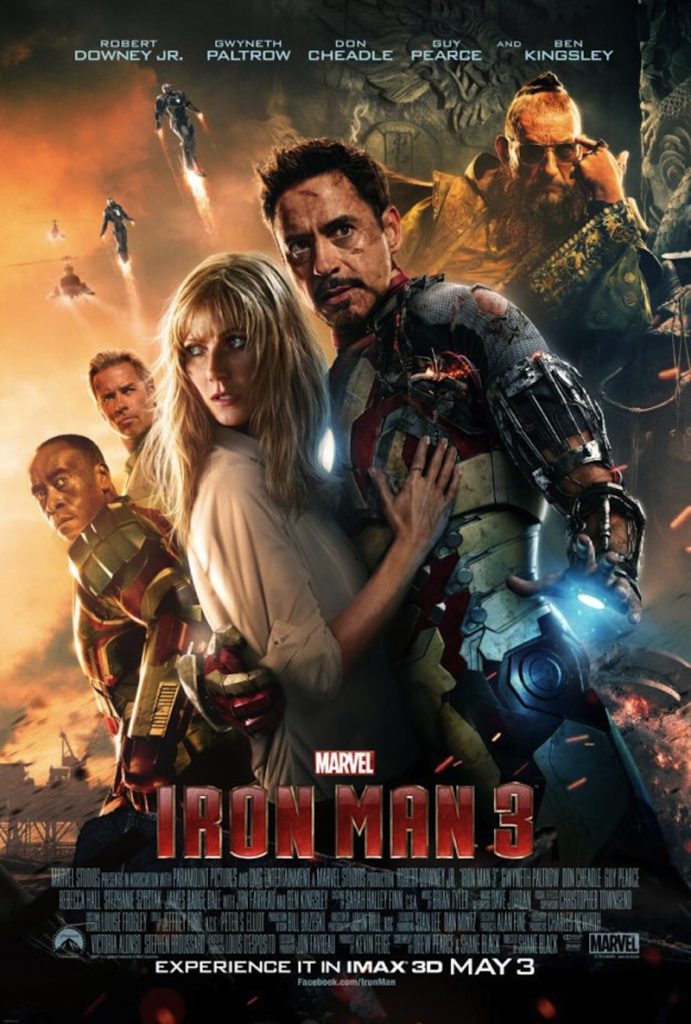
Iron Man 3 Review


Director: Shane Black

Writers: Drew Pearce, Shane Black

Starring: Robert Downey Jr., Gwyneth Paltrow, Ben Kingsley, Don Cheadle, Guy Pearce, Rebecca Hall, Paul Bettany, Jon Favreau, William Sadler, James Badge Dale, Stephanie Szostak

Synopsis: After the epic battle fought alongside the Avengers, Tony Stark (Downey Jr.) is hard at work on further Iron Man advancements. However, with all work and no play, along with the trauma of nearly dying in the New York fight, he’s been left relatively scarred. Even with bouts of panic attacks, vicious terrorism erupting from The Mandarin’s outfit forces Stark to overcome his anxieties and help to protect and save his country.

Spring has finally started to dawn – the sun is shining, the wind’s no longer creating that numbing cold effect, and the big movies are upon us. So, in an interesting turn of events, how is it that the first major blockbuster of this year has an abundant wintery/Noël ambience? Check the director’s name (Shane Black) and you have your answer – the Lethal Weapon, The Long Kiss Goodnight, and Kiss Kiss Bang Bang writer/director is a slave to his favourite holiday season, bringing it in to his take on the Iron Man series. Using the Christmas setting is not an intrinsic aspect of the narrative, but it does underscore the director/writer’s presence, making this another distinctly Black film (and for those who know of his talent, that can only mean good things).

Much like Joss Whedon was able to expertly handle the Marvel universe whilst putting his own stamp on The Avengers (witty dialogue and memorable group dynamics), Black and co-writer Drew Pearce have an astute knack for balancing the extravagant and everyday. On top of this, it wouldn’t be a Shane Black film without the noir pastiche; after Downey Jr. And Black’s triumphant try at the genre with Kiss Kiss Bang Bang, it seems the duo were made to work at that style. Whilst Iron Man 3 can’t be a complete exercise in film noir, it includes a winning combination of a protagonist’s voiceover, an existential crisis, and the twists and turns of investigation.

The Mandarin is the most elusive villain we’ve seen in the Marvel lot so far, perfectly fitting for what Black is going for with number 3. The aforementioned investigation by Stark is riddled with rough encounters with henchmen and femme fatales, and red herrings that no reviewer should have the indecency to reveal. The film’s first 20 minutes (mostly shown in the trailer) is bland and uninspiring, merely setting up Stark hot on the Mandarin’s case; it’s purely there for expositional reasons and can be completely forgiven once the takes place. Joining in the villain role is Guy Pearce, not as scene-stealing as Sir Kingsley but charismatically caustic all throughout. He plays a large role up until the end, making it twice as exciting with his take on the Killian character. 

The last half, with a surprisingly gripping last 20 minutes (so far removed from the boring brawl in Iron Man 2), leaves you realising that this film may be Marvel’s best so far. Forgetting the largest disappointment that, by the end, Rebecca Hall has had very little to do, there is still an epic sky-fall set-piece and a verifiable threat that does make you ponder over various outcomes.

Moving past how it starts and it ends; it is the middle section that holds the most value. As Tony gets accidentally exiled the film turns into a character-driven search-for-the-soul drama with imagery reminiscent of Sergio Corbucci’s Django, Frank Capra’s It’s A Wonderful Life and Billy Wilder’s Double Indemnity. It’s an assured cinematic journey that just happens to be in the familiar, commercial Marvel universe. The production value may be high but there is no tawdry texture to this huge blockbuster – it’s a rich film, helped enormously by the writers and director’s approach.

As mentioned, the beginning contains nothing more than some story set-ups and introductory action. Nevertheless, as dull as it may seem in comparison to the last two thirds, the first section can almost be seen as warm-up of what’s to come. The quips and witticisms of the outset are common but nothing than what’s in store for you after the first hour. You can always expect Black to write irreverent and sharp “banter”, and know well by now that Downey Jr. is a master at delivering it. Funnier than most of the comedies from the last few years, Iron Man 3 has some exceptional dialogue in it – magnified, in passing, by the odd jibe from minor characters (such as henchmen giving their two cents, or citizens of a rural town hilariously speaking their mind).

If Marvel continues on like this there is no telling how well they will do. From Favreau, to Branagh, to Whedon, there is some great talent underscoring the success; Iron Man 3 further reminding everyone of that. Expect so much more from what the trailer shows you, and stay for the customary post-credit scene – be enthralled by another superhero movie. This review had to leave out saying more than it could, as a few surprises await (the PR team have done a tremendous job of saving so many treats for the final thing), but know this – it is an excellent noir-superhero hybrid raising the bar high once more for those that follow.

****

Friday, 5 April 2013

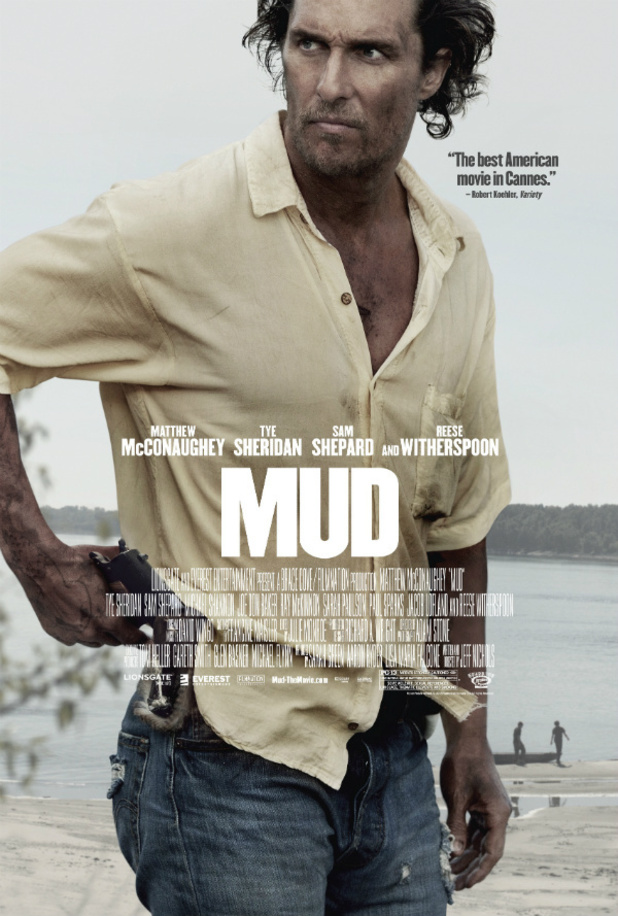
Mud Review


Director/Writer: Jeff Nichols

Starring: Tye Sheridan, Matthew McConaughey, Jacob Lofland, Reese Witherspoon, Sam Shepard, Ray McKinnon, Sarah Paulson, Michael Shannon

Synopsis: Two teenage boys, Ellis (Sheridan) and Neckbone (Lofland), encounter a mysterious man on a deserted island deep in Arkansas. Initially they feel perturbed about his deserted-dwelling life but start to find out more about his personality and his reason for a nomadic existence.

Having started off with a hard-hitting drama, moving onto a film combining nightmares and a humdrum reality, to now crafting a film of magic-realism, Jeff Nichols consistently casts an interesting eye on the “American way”. His films embed themselves into your psyche and show you the detail and charm of the (Deep) South lifestyle. Whereas his first two films presented honourable characters, there was always a darkness itching away at the aesthetic; for Mud, he shines a mostly-beautiful light on the ethereal essence of his hometown.

First thing to be said about the film is its value up on the silver screen. The colour and sound has a John Huston/John Ford-type vitality when reflecting certain aspects of Americana. Cinematographer Adam Stone has, since Shotgun Stories, captured some beautiful imagery for Nichols’ work, with Mud highlighting that even more. His imagery stuns from time to time – recapturing that traditional Hollywood glow (despite it being a relatively independent production). The only downside to the picture quality is the lack of a full 35mm print cinematic release – a format that would spectacularly show-off the film’s beauty.

With pastoral, pictorial punctuation the film may drag for some. However, those won-over by the coming-of-age story alongside fugitive drama, will never grow weary of the steady pace. If anything, the last 20 minutes, that includes a touch too many scenes, serves as a reminder to the wonders of the film’s measure and tone. Following the young boys as they discover girls, their American back-garden, and the perils of some adult livelihoods, feels like the purest of any stories. Certainly in-keeping with Nichol’s Tom Sawyer-inspiration, and his obvious loyalty to the citizens of the South, makes the film sincerely enjoyable and fascinating.

To begin with the film’s epoch is not wholly clear, reinforcing the timelessness of Mud; it could take place in from anywhere between the late 1800s until today. Furthermore, the writing and execution feels elegantly archetypal, making the film an immediate classic.

Helping it along its way, other than the filmmakers’ efforts, is a sterling cast led by Tye Sheridan and Matthew McConaughey. The former is a prodigy, stripping the stardom away from all those famous he shares scenes with. One confrontation with him and McConaughey’s Mud leaves you in awe (just as it clearly did the Killer Joe star, judging from his reaction). With fantastic support from newcomer Jacob Lofland, Reese Witherspoon, Sam Shepard, Ray McKinnon and Michael Shannon (never seen so down to earth on screen since...ever), Mud greatly advertises the ensemble cast and community spirit of filmmaking. Having many of the Arkansas citizens as extras on the film, and acquiring a cast of brilliant character actors, injects an authenticity whilst marking the creativity of a crew. 

Two stars – one at the height of his career, the other exceptionally establishing his – leading the way for Nichol’s third triumph, in a story very touching, exciting, and funny. Mud can be categorised in a number of ways but perhaps, most interestingly, it is a story about love and trust. How the extraordinary circumstances teach Ellis and Neckbone about friendship and devotion unravels illustriously. Tied to the warming aspect of the story is a sunlight that basks the film in a luminosity, making Mud a quintessential summer movie, and a lasting one at that.

*****
By Piers McCarthy. Also posted on LiveForFilms

Monday, 1 April 2013

A Late Quartet Review


Director: Yaron Zilberman

Writers: Yaron Zilberman, Seth Grossman

Starring: Christopher Walken, Philip Seymour Hoffman, Catherine Keener, Mark Ivanir, Imogen Poots, Wallace Shawn, Liraz Charhi

Synopsis: A well-established string quartet begins to suffer some setbacks after one member is diagnosed with Parkinson’s and the others get mixed up in love and affairs.

Given the names on the film’s cast list there’s little chance of A Late Quartet being badly-acted. Whilst they’re not the best characters each actor has played, there is a flawless quality to their performance. Christopher Walken, who in the last ten years has often exaggerated his persona in comedy, is the star of this film. He isn’t given as much screen-time as the rest – and not nearly as much drama – but his arc is quietly melancholic which has a much more profound effect on the film’s emotion. One scene where he reflects on his life and his losses during a sombre piece of music powerfully reminds you that he is a deserved Oscar-winner and acting icon.

The three remaining quartet members are similarly fantastic, given story-lines to eat up in all their critically-acclaimed glory. You are constantly reminded of the need for cohesion in this type of group and so watching as they break apart is expectedly dramatic. Whilst Walken’s character poignantly ponders over his aging and disease, the other three wrestle with love and control in the ranks of their quartet. It is, as you imagine, a variety of tearful arguments, physical clashes and loud yelling. They all know how to deliver these moments with the exact amount of intensity and prowess, making A Late Quartet seem like a classic melodrama.

They all handle their characters wonderfully, making them seem as real as the actors’ practice with their chosen instruments. Only on occasionally do you see the film slipping into clichéd territory, and at these points you feel slightly cheated (as if Hollywood producers felt compelled to bring some familiarity to the floor). The film is a long, dialogue-heavy meditation on support and collapse but it feels mature in its ability to do that without too many truisms of the genre.

A deft exploration of relationships and life, coupled with the interesting focus on a tight quartet group, makes A Late Quartet very touching. Its focal point of the quartet and Beethoven’s elaborate Opus 131 will not make it a box-office behemoth, though for its chosen demographic it will certainly affect and entertain.

****
By Piers McCarthy. Also posted on LiveForFilms

Wednesday, 13 March 2013

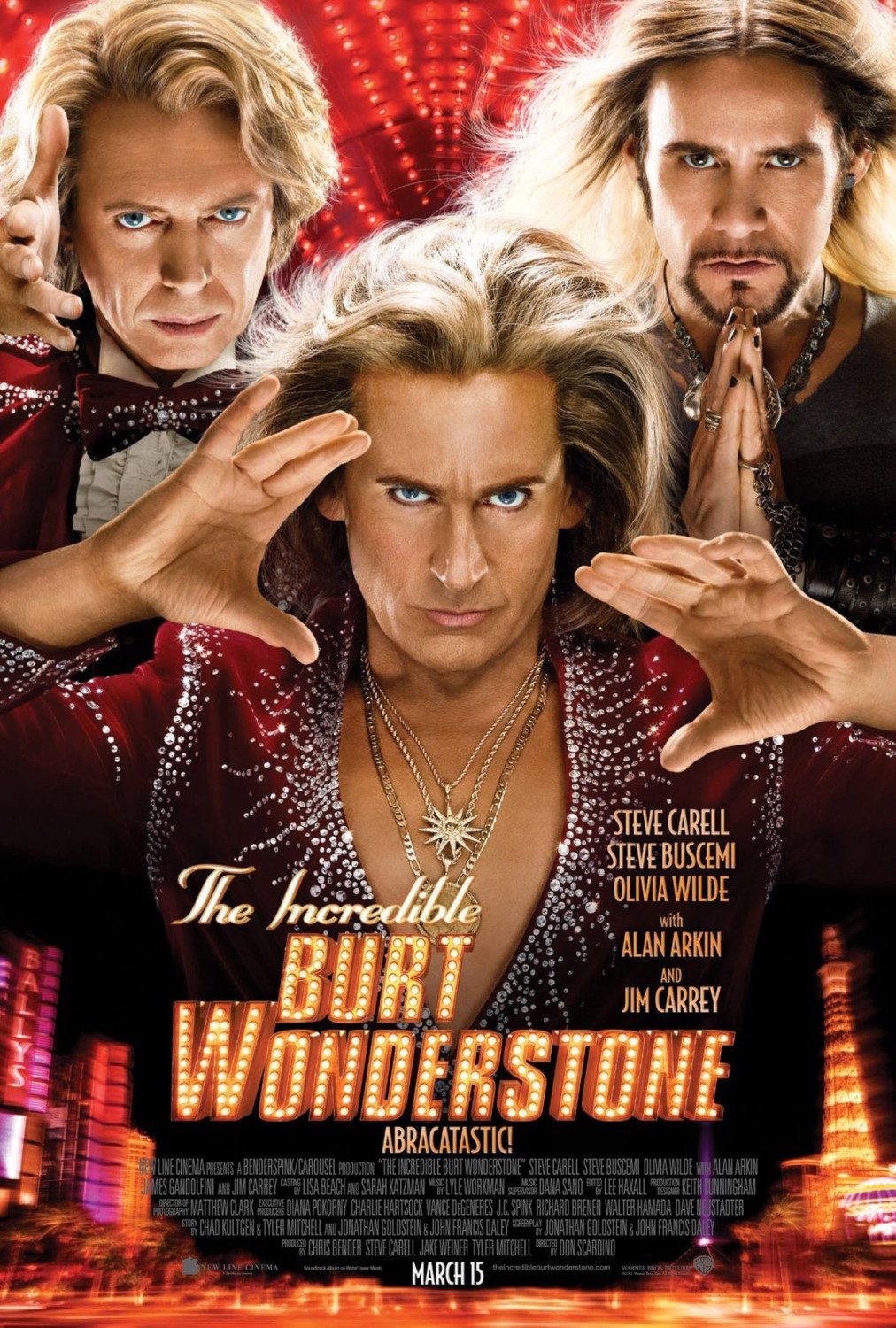
The Incredible Burt Wonderstone Review


Director: Dan Scardino

Writers: Jonathan M. Goldstein, John Francis Daley

Starring: Steve Carell, Steve Buscemi, Olivia Wilde, Jim Carrey, James Gandolfini, Alan Arkin, Jay Mohr

Synopsis: Burt (Carell) was never a popular boy at school and neither was his best friend, Anton (Buscemi) but together they used magic to find happiness, and worked so hard that they became a hit Vegas act as adults. However, after many years doing the same act friction is developing between the two and hot new magician Steve Gray (Carrey) is jeopardising their hopes of an ongoing career.

Comedy of the last century has been mainly irreverent and extremely adult. The Hangover, Superbad and Bridesmaids are all the polar-opposite of family entertainment. The other lot of hit comedies have been mostly irrelevant; 12A releases like Little Fockers, Grown Ups and Mr. Popper’s Penguins. That’s unfortunately one of only ways to categories successful comedy cinema of late – a collection of cheap or crude clowning around. The cast and premise of The Incredible Burt Wonderstone looked as though it could change things up somewhat but it sadly reiterates everything that’s wrong with contemporary comedy.

Starting off with a clichéd set-up of Burt Wonderstone’s youth (bullies chasing him home, an uncaring mother and a nerdy kid as his only friend) does the film no favours in making it seem fresh. The only stand-out aspect of the opening is a beautifully surreal piece of casting with Alan Arkin as a famous 80s magician introducing his “how-to” magic video on Burt’s TV. Arkin will later settle into his familiar grouch persona but his briefly jubilant and over-the-top acting (perhaps only funny to those aware of Arkin’s persona outside of the film) is amusing.

As cruel as it is to criticism the child actors, these particular two playing young Burt and Anton are beyond awful, hamming it up (maybe under Dan Scardino’s direction) to within-an-inch of the film’s “life”. As the film moves into present day, with Carrel and Buscemi, it’s a slight relief to have the children gone. Nevertheless, despite Carrel and Buscemi as the leads, they are equally terrible. Carrel puts on an incredibly forced deep voice (a characteristic better suited to Will Ferrell) whilst Buscemi quietly reads through his lines, none of which enable him to get a laugh.

With a cast as hilarious as this it’s a profound shock to see everyone doing so badly. Jim Carrey occasionally delivers a quip or performs a comically contorted face, bringing some humour back, but these moments are few and fleeting. Carrel and Carrey back together again after Bruce Almighty was a definite selling point but something about how the characters are written leaves you wanting to see none of them. Burt is a bastard throughout most of the film and so is Grey; the only difference between them is that the former redeems himself (though even then he still appears fairly cold by the film’s joyous end*).

The funniest scene (and it really does get the entire audience howling) is in the last 5 minutes. In most cases this would be a fantastic way to end a comedy – going out on such a high – but instead, it reminds you of just how unfunny the last 95 minutes were.

The Incredible Burt Wonderstone brings dangerous attention to the tawdry aspect of performance and showmanship. Burton and Anton's show is funny because it's terrible; captured so well because we are looking at it from within a poorly-constructed presentation (an Inception-esque exercise in criticism). The irony of the title is so well-pronounced - it's a critic's dream tool.
**

*I would have added a spoiler tag but the film is so predictable you know the course of its narrative from the get-go.
By Piers McCarthy. Also posted on LiveForFilms