Showing posts with label Flickering Myth. Show all posts

Wednesday, 29 January 2014

Interview: Ian Nathan, author of Masters of Cinema: Ethan and Joel Coen


With Joel and Ethan Coen’s latest – Inside Llewyn Davis – due out today, I’ve returned to the filmography of the two enigmatic brothers, and a Masters of Cinema book dedicated to them. The author of said book is Ian Nathan, executive editor of Empire Magazine, author of Terminator Vault (2013) and Alien Vault (2011), and a contributor to numerous publications including The Times and The Independent. Sharing his thoughts on the process of writing the book, and his own exploration of the tricksy Coen brothers, here is what Mr. Nathan had to say:

How easy was it to balance the research and writing of this book with your work at Empire Magazine?


This is always tricky in terms of sheer workload. Books are just hard work, and soak up your time. I had many late nights and early mornings (which were the most productive, so it turns out I am a morning person) and the odd lunch hour. My bosses at Empire were kind enough to turn a blind eye to the occasional paragraph written on work time.

Actually, the harder element was clearing the headspace for each part of your life. I became consumed with the Coens, so much so that I could think or talk of nothing else. My mother would call, and I would test her on The Big Lebowski's bowling rules, I would do a tea round at work and tell the kitchen on my new ideas for the subtextual significance of Freddy Riedenschneider's fruit cocktails. Keeping my head in the Empire game took concentration.


How did this differ from your work on your Alien and Terminator books?

This was quite different, and a little closer to how I like to write about film. Both of the Vaults represented journeys into history, a kind of thrilling and perilous movie archaeology, where I lived in fear of not saying anything new. But they were very concentrated stories, and very structured — biographies almost. The Masters of Cinema guide to the Coens was more analytical, more a marriage of history with interpretation. And the tapestry of riddles presented by the Coen filmography was too tempting not to get analytical on their ass. So to speak. They, of course, would laugh at my foolishness.


Who is the Ron Neter in your life? Did someone suggest you write the book or was it something you had in mind for a while?


I wish I could tell you about the moment or the person who made it all happen, but the truth is rather more prosaic I'm afraid. I had a few contacts at Phaidon, which at the time owned the famous French critical journal Cahiers Du Cinema, and were publishing books under its name. I met with the commissioning editor, and as we talked through the things she wondered if I was into the Coens… I swiftly bored her with a brief sketch of Barton Fink as a study in psychotic delusion brought on by extreme stress. She claimed to be impressed.


Did you have a lot of discussions with fellow film-writers about the Coens for the book?

I did, both in terms of talking to Empire writers and other critics afresh (and its not hard to nudge a critic into giving their opinion on the Coens) and having a history of talking over this stuff since I first got into this game. The book is now long past its creation, but I still happily engage my fellow Empirite in waxing lyrical over former Coen glories, and the arrival of Inside Llewyn Davis has sparked yet more yapping…


“Question God, the universe or the Coens and your invite trouble?” Did this idea haunt you at all during the preparation and writing of the book?

It kind of did. The book was overshadowed by the fact the brothers flatly refuse to engage with their films on any kind of meaningful level. And yet there is no missing how the films contend with notions of fate, justice, religion and what we deserve (or not) from the universe. They so often treat their characters as lab rats in some vast philosophical experiment. We shouldn't dare to question seems to be an abiding message. But to quote poor Larry Gopnik, "Why does he make us feel the questions if he's not gonna give us any answers?" The need for answers is something fundamentally human, but a risky business all the same.

Did you ever think of trying to interview the pair of them for this book?

Well, I have interviewed them five times (and they never remember me!), so I was well aware how unwilling a participant they each are in their own mystique. So it would be relatively futile to seek confirmations to my theories in person. Also, the structure of the book was very much an outside-in format — my search for where these films might come from, to what that elusive elixir Coenesque might be made of…

How did you go about quantifying the analysis of each film? Did you end up expanding on some films more than others (there’s less said on The Ladykillers and Intolerable Cruelty, understandably, for example) – was there much difficultly in editing it all?


There was obviously an overall structure and word count which dictated how much I could do on each film, and I weighted things to either the relative importance of the film in the Coen canon (Fargo being more important than The Ladykillers say) and how much I felt I had gleaned about the film in questions (The Big Lebowski kept revealing more and more things; Barton Fink seems to me almost the key film). I did end up overwriting horribly, there was just so much to say, and spent a painful last couple of months cutting away things I really liked. There is a director's cut version of the book no one will ever see!


Were there any elements of their films that involved heavier research (Jewish religion, Biblical references, their muses, etc)?

The childhood was important, tracing where the ideas might have been nurtured. But the interviews they do never reveal much. So it was a question of piecing things together, from all number of books, articles, interviews, and pre-existing analyses of their films. Patterns emerged that belied their flippancy toward their own style and content. But it is the films that are the true Rosetta Stone, and the more you look, the more you see.


Near the end of the book you discuss the “outward modulation” of the Coens’ sensibilities. Would you revisit that subject a few years and films down the line?

Christ did I? I must have had too much coffee that morning! But, yes, I would love to keep examining the growing arena of their world, which still remains unshakeably Coenesque. Llewyn Davis is both perfectly them, and a new flavour: melancholy, darkly romantic, and self-questioning (the futile quest of the artist). Ironically, you could say it has an inward modulation!

Have you got a favourite in the Cahiers du Cinema Masters series?

I did enjoy the Thierry Jousse book on David Lynch greatly.

[Can’t end the interview without asking] What’s your favourite Coen brothers film?


Ah, picking between the kids. If you put a gun to my head (and you must always "put one in the brain") I return to Miller's Crossing again and again to drink in its handsome style and listen to that pulsating script – not a second is misjudged. But Barton Fink is so important, and A Serious Man, and Fargo… God, what about The Big Lebowski… Hudsucker, I love Hudsucker! Don't make me do it.


Interview by Piers McCarthy


Huge thanks to Ian Nathan for taking the time to answer these questions. His Vault books are available on Amazon and his Coens book can be bought off Phaidon 

Also posted on FlickeringMyth.com

Additional essays (O Brother Where Art Thou? and A Serious Man) on the Coen brothers can be found through this website, from author Ryan Hogan. 

Thursday, 24 October 2013

The Walking Dead Season 4 Episode 1 Review

“Previously on AMC’s Breaki---” Hold on a minute, that brief sound clip will never again be heard on live television. AMC has said goodbye to the Vince Gilligan masterpiece but still retains the likes of Mad Men and The Walking Dead. Whereas Mad Men has a more niche audience, The Walking Dead grows ever-popular, with a group of geeks in adoration of their favourite characters (we’re looking at you, Daryl). With that in mind, The Walking Dead’s fourth season started with a 16.11 million viewership, the highest it’s ever had. It will never see the same hype as something like Breaking Bad, though its continual effort to be seen than something more than just “that zombie TV show” is very commendable. Season 4 begins in a far less exciting manner than the third season’s opening, yet is still able to have us completely transfixed.  
Major spoilers follow

AMC’s catalogue of soundtracks eclipses most other networks. Thomas Golubic, “30 Days Without an Accident’s” music supervision begins the episode, with a little ditty: “Precious Moments” by The Stanley Brothers. The irony is palpable – as Rick takes out the headphone buds, the sound shifts to that of growling, scratching Walkers – that memories in the Walking Dead’s world are mostly cutting as reality becomes filled with the undead. Golubic had also worked on Breaking Bad and Six Feet Under (to name just two), a great crew member, able to make a scene work on music worth alone. It sets up the workaday nature of the new colony, with that eerie quality that no matter how cheery you can try to be, death still surrounds everything.

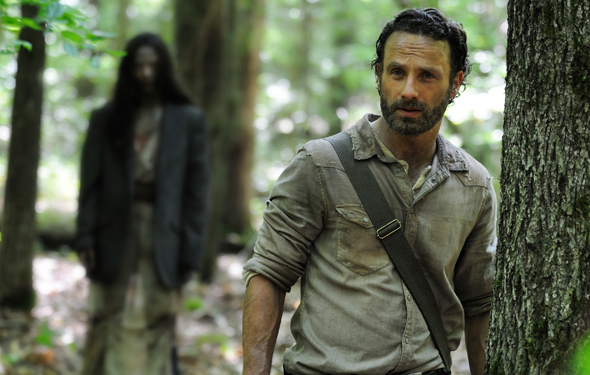
Apart from the brief musical epilogue, season 4 starts with a harrowing image of an eyeless zombie “watching” Rick. Bleeding eyes and absent pupils, it sends a jolt through you; the work of the show’s master make-up team. Foreboding and distressing for relatively unknown reasons (as the show’s audience has grown used to the macabre), it is a moment than seems very definitive – an omen of what to come.

So in the six/seven months since we left off apparently a fair few things have happened. These mostly relate to relationships forming and duties assigned. Tyreese is with a beautiful woman named Karen, Beth is with a muscular newcomer called Zack, and Carol and Daryl may or may not be a couple. In addition, Everybody Hates Chris’ Vincent Martella shows up as Patrick, who will become the final moment’s most integral part. Lastly, established characters get given some development, such as Bob (The Wire’s Lawrence Gilliard Jr.), Michonne (returning from unsucessfully hunting “him” – the Governor), and Daryl (as much of a celebrity within the show as he is outside of it).

In terms of hunting, there are no suspecting villains ready to find and kill (though you can bet the Governor will return) so it’s only food needing the group’s time and effort. Hershel and Rick head out into the forest for game and vegetation whilst Daryl, Tyreese, Zack, Bob, Glen and Michonne go looting a supermarket. As Hershel leaves Rick, our protagonist stumbles on a starving, filthy survivor out in the woods. Greyed and skinny, she reeks of desperation and pity. Rick, helpful as ever, offers her food and a chance to bring her back to the prison.

Rick’s stint with the stinky Irish woman is a slightly confusing part of the episode – Clara takes him to her camp (for an interview situation, where Rick will determine whether Clara and her husband are safe for his sanctuary) where he finds her talking to a head under a blanket. Not easily distinguishable under that cloth, the decapitated husband is a mere mystery until a brief shot at the end of the scene. Her reasoning and emotions are somewhat baffling – her will to survive until meeting Rick and then offing herself. Rick stands there upset and perplexed by her motivations, finally asking her the interview questions that have only slight bearing on the poignancy of the programme. Her story would have been quite interesting to have learnt about – an exile of her homeland, carrying the head of her husband around, surviving on barely anything – but she’s dropped after such little screen time. Fans of the show should know this to be realistic and in-keeping with Kirkman’s universe, but on occasions there are missteps – Clara being one of them. 
Meanwhile, Daryl and company head to the store. Starting off fairly lacklustre, the camera pans up from the door they entered in to the roof – packed with zombies and a crashed helicopter.  It’s nothing jaw-dropping, nor is it when Bob makes a ruckus toppling a shelf full of alcohol (a great piece of storytelling where we realise Bob’s an alcoholic, faced with a haul of free wine). However, the damp, sunken tarp, holding the weight of 20 or so bodies and a helicopter means the undead fall through into the shop. Bob’s liquid temptresses become a danger not only to himself but those around him – an implicit part of the episode’s drama and action.

As the hoard drop from the ceilings the scene suddenly goes from tedious to tense. The effects and stunt work usually have their shining moment at some point in an episode and this is it. Just before the break, one zombie falls to the camera (a skewed POV shot of Bob’s), growling as he heads into focus. Put simply: it looks fucking cool.

Effects work are similarly superb, with purely gross moments of gore. Skin ripping away, heads being pealed apart and explosions of impact on the decrepit bodies are each scarily real. It adds to the electricity of the moment, where everything seems too messy.   

Daryl and Glen – two key players in the cast – have their moments of peril, worrying for a show that is known for killing off anybody. Fortunately they survive, something that cannot be said for Zack. As the helicopter looms over the crumbling roof, there is no time to save him and the only saving grace from it all is the helicopter would instantly smush him. 


“30 Days Without an Accident” gets its name from Beth’s reaction to Zack’s death. Not “crying anymore” – changing her X amount of “days without an accident” sign back to zero. Her maturity in accepting his death follows the tone of the developing show – now news such as Maggie not being pregnant, Tyreese fearful of walkers in most situations and Rick’s constant fear of losing people is dealt with more philosophically.

The Walking Dead can be the best thing on TV, and merely average other times. Season four shows plenty of promise, without being a game-changer. It’s the final shot – the cliff-hanger – that means business. Patrick, coughing and sweaty, stumbles to the bathroom where upon he drops dead. Closing his bleeding eyes (like that of the eyeless zombie outside), he lies there deceased. Until, of course, those eyelids open once again, revealing the smoky glaze of his lifeless pupils. He’s a walker, inside the sanctuary, probably set to cause some trouble. Episode 2, we’re waiting...

Also posted on Flickering Myth

The Wicker Man Final Cut Review


The Wicker Man: The Final Cut DVD
Director: Robin Hardy

Writer: Antony Shaffer

Starring: Edward Woodward, Christopher Lee, Diane Cilento, Britt Ekland, Ingrid Pitt

Synopsis: Police sergeant Howie (Woodward) is sent to a remote Scottish island to search for a missing girl. His inquiry proves fruitless once he realises the whole town seems to covering something up.

For the meme generation, the passing mention of The Wicker Man will more likely involve people shouting, “Aaahh, the bees!” than someone commenting on the classic 1973 horror. Aspects of Robin Hardy’s The Wicker Man have aged, it must be said, overshadowed somewhat by Nicolas Cage’s modern remake. To stress, overshadowed in the sense that Cage’s version was so absurdly awful it’s distinctly soured the title.

The rerelease of the original aims to rid the memory of the remake, an ambition easily accomplished. The restored version (having been reviewed on DVD) is not as magnificent as more recent restorations. It has enhanced the sound and removed the scratches, but colour grading is not as polished as would be desired.  The special features and the trinity of versions included in the new release is the defining aspect – a final, complete, Wicker Man.

The Director’s Cut runs wonderfully smooth – without the jagged flashbacks and clumsy editing seen in previous versions – a triumphant example of the mystery/detective narrative. As normal as the form appears, what is included within it is not. The film features an island of folk-loving townspeople, who are bound together by paganism unknown to the tragic Howie character.

Woodward as the pious and stoic lead is terrific. Dogged and doomed, he leads us through a series of interviews with the islanders, leaving the audience to pick up on things he doesn’t see. As the patsy, he gains immediate empathy, with the end bitterly upsetting. Christopher Lee as his foil has little screen-time and achieves a mysterious quality perfectly fitting for the film. It seems that even as the end answers some questions, Lee’s Summerisle is still a questionable figure. You get the satisfaction of knowing and liking one character, and despising and querying the other. Woodward and Lee made a superb hero/villain duo, immortalised by their only cinematic coupling in The Wicker Man.

Heralded the best British horror film by many, The Wicker Man does indeed boast an exemplary script (by Sleuth author, Antony Shaffer) and impeccable direction. Woodward and Lee are characteristically brilliant and the atmosphere each man creates (insecurity and danger, for example) is timeless. The film will last for decades to come (even if some of the Morris dancing and folk chants do not), now serviced with its “definitive” legacy.
****
Also posted on Flickering Myth

Tuesday, 9 July 2013

The Long Riders Blu-Ray Restoration Review


Director: Walter Hill

Writers: Bill Bryden, Steven Smith, Stacy Keach, James Keach

Starring: David Carradine, Keith Carradine, Robert Carradine, Stacy Keach, James Keach, Randy Quaid, Dennis Quaid

Synopsis: Following the Youngers, the Jameses and the Millers – all notorious outlaws back in the Old West, who raided and stole from banks across the country.

The Western film craze was said to have ended with Sam Peckinpah’s The Wild Bunch, though there was still one director adamant at making his own. Walter Hill – whose work before The Long Riders foamed at the mouth with motifs reminiscent of quintessential Westerns – always needed to add to the genre. The Long Riders may not be a masterpiece yet it’s grounded in appreciation and understanding of the specific style, constructed fantastically well.

Being released in 1980 it was a striking and off-beat project in amongst the buddy movies, spoofs and slasher movies. However, the other Western from that year, Heaven’s Gate, became one of the biggest box-office bombs of all time, leaving The Long Riders on treacherous ground. Without looking at its abilities to thrill, Hill’s Western is poetic and beautiful. It can still amp up the action to a spectacular degree though it feels more like an elegiac hark-back to what was once the most popular genre at the multiplex.

There are a lot of truisms of the Western brazenly scattered throughout; Hill clearly loves to show and pastiche his muses. Cinephiles will notice the slow-motion shots in the chaos of gun fights, a reminder of Peckinpah, some Arthur Penn and, most importantly, Akira Kurosawa. As Hill notes in the “Slow Motion: Walter Hill on Sam Pekinpah” featurette, the effect was used to extend a certain nightmarish quality of the brutality. In this he succeeds, just one element in a bountiful display of care and craft that has gone into the direction of the film.

Hoping to really capture believability in his biopic of the gang of brothers, Hill cast actual acting siblings (the Carradines, the Quaids and the Keaches). This creates an undeniable chemistry and bond on screen, enabling empathy often absent in these types of films. Having the Carradines sharing the lead characters with the Keaches, is far more interesting than if the Keach brothers had written the script with heavy focus on Jesse and Frank James. It’s a selfless move on their part to portray the band of outlaws and not only the most famous of the group. In fact, the James brothers are the least interesting to watch on screen (not a criticism of the acting), with each Younger having far more fascinating traits and relationships.

Cole Younger, played by David Carradine, is in an on-and-off-again relationship with a town whore played by Pamela Reed. Reed is wonderful, picking up on the headstrong, tough characteristic of the Western prostitute and having fun with the Benedict/Beatrix battle of wits with Cole. Never focused on too heavily, or causally represented, this is a core theme of the film – the group’s link with domesticity and women. Cole and Reed’s Belle are at the forefront of this arc, promoting the multifaceted nature of the script.

The downside to the film is how the story eventually dithers over a conclusion. Jesse James is always the prime suspect in the chase between the Pinkerton agency and the outlaws, though the writers continually find a way to balance out this attention until the end. The Ford brothers eventually are granted their spotlight, poorly initiated into the chronicle, especially in comparison to The Assassination of Jesse James by the Coward Robert Ford. Much like the Western genre, the film ends with a whimper and not a bang, sadly.

Looking and sounding superb, The Long Riders is a well-deserved Bluray transfer. Ry Cooder’s score melodically moves us through the years of the Youngers and Jameses whilst Ric Waite’s cinematography stunning snapshots it all. It begins looking as though it may have aged, but once the first 30 minutes pass (also getting the half hour of heavy exposition out of the way), it’s invigorating.

**** 
Extras: Outlaw Brothers: The Making of The Long Riders with Walter Hill, James Keach and Robert Carradine (60 mins) – very detailed overview of the film from a contemporary standpoint
The Northfield Minnesota Riad: Anatomy of a Scene with Walter Hill, James Keach and Robert Carradine (15 mins) – pretty great to see how some of the amazing stunt work was achieved.
Slow Motion: Walter Hill on Sam Pekinpah (5 mins) – even with such a short run time this is nicely eye-opening and instructive.


Also posted on Flickering Myth

The Iceman Review

                                                                 Director: Ariel Vromen


Writers: Morgan Land, Ariel Vromen

Starring: Michael Shannon, Wiona Ryder, Chris Evans, Ray Liotta, David Schwimmer, Robert Davi, James Franco, Stephen Dorff

Synopsis: Chronicling the life of Richard “The Iceman” Kuklinski (Shannon), a near-emotionless contract killer for the mob.

Just before he becomes a global superstar with Man of Steel, there is still opportunity to see Michael Shannon doing what he does best – troubled, embittered characters in independent films. Growing ever-more popular since his Oscar-nominated role in Revolutionary Road, it’s still refreshing to see Shannon take on smaller roles in what are essentially cult films. My Son, My Son, What Have Ye Done, Bad Lieutenant and Take Shelter (one of the best films of recent memory) have all been minute films in comparison to what will be the next Superman movie, and all promote Shannon’s great talent. The Iceman feels slightly bigger (with an all-star cast and 40s-80s expensive set, props and costume design) but is contained in its meditative portrayal of one of America’s most prolific hired hitmen.

A fan of Michal Shannon is a fan of rather slow and sometimes solemn cinema. For those looking for a contemporary action-packed, bloody gangster film, The Iceman won’t completely satisfy. The events that unravel are frequently paired with gory violence and gun-shots but this isn’t a modern Goodfellas. Instead, Ariel Vromen has made a gloomy, dramatised biopic of an unreadable man. Kuklinski is a quiet sort whose purpose and drive in life is never completely detailed. In following a mysterious figure for 100 minutes there has to be something intriguing to warrant interest. It was similar with Mesrine, and like the French criminal film it is only the lead actor who manages to keep you from nodding off. Mesrine’s Vincent Cassell is, in many ways, a European version of Shannon who acts with his eyes and with very little expression, yet still conveys a wealth of emotion by some strange happenstance. Both warrant your attention in nearly everything they do but they cannot continually act within stand-out films. This is the case for The Iceman which is good, but not great.

Performances are terrific all round (though David Schwimmer playing a gangster is jarring even with nine years passing since Friends) and it’s usually very aesthetically pleasing. None of these factors, however, can ever save a film from a dull screenplay. The Iceman’s life is an intriguing one but it’s missing something electric and poignant. The end tries to surmise the man’s life in a powerful way, yet fails somewhat by the modestly mundane proceeding 95 minutes.

For fans of Michael Shannon it is worth watching; as he ages through the film you can see Shannon’s performance evolving progressively, advertising his innate acting skills. Ray Liotta joining him (adding another mob-man to his character catalogue) and further support from an unrecognisable Chris Evans give the film some interesting scenes. Nevertheless, on the whole, the film is insubstantial in its exploration of Kuklinski’s life leaving it only as an average piece of entertainment.

***
Also posted on Flickering Myth 

Thursday, 2 May 2013

Chimpanzee Review


Directors: Alastair Fothergill, Mark Linfield

Writers: Alastair Fothergill, Mark Linfield, Don Hahn

Synopsis: Disneynature’s new documentary follows the life of an energetic yet vulnerable young chimp, Oscar, living deep within the Taï rainforest.

Introducing children to the natural world may be a daunting prospect for a parent – it’s full of copious mating, fights to the death, and often nightmarish imagery. Whilst David Attenborough’s seminal series of wildlife documentaries are not to be missed, they are not always toddler-friendly. In response to this Disney have created a new independent film label – Disneynature – to show the twee aspects of animal life, as well as some of the perils.

Being a Disney product, Chimpanzee is decorated with many darling elements, such as bouncy music, funny recordings of animals falling or hitting one another, and scenes of tenderness. As well as this, they also introduce a narrative not-so-dissimilar to their animal-led classics such as The Lion King, The Fox and the Hound and The Jungle Book, with villains roaming and danger lurking. Showing a story unravel, and having characters and a “plot” to follow will inevitably make this easier for the little ‘uns; it promotes the basics of story-telling and simplistic ethics – “acts of evil and good appear like this, or like this”.

The story of the chimpanzee protagonist, Oscar, was supposed to follow his early life with his mother and nothing much more. However, mid-way through the shoot Oscar’s mother sadly died and the filmmakers recorded something miraculous happens – his adoption by the alpha-male of the group. This is Disney’s serendipitous injection of joy and hope into the film and it works wonders. Unfortunately, this event happens very late in the movie and the focus on it is not that extensive. There are a few moments where Oscar learns different tricks of the trade, and these suffice as fillers to a quite average chronicle.

We also continually crossover to the villainous chimp tribe, led by Scar (another discernible Disney reference), who, when coming into contact with Oscar’s family, can never be told apart. Without the forbidding score and occasional displays of rage, there is a lack of tension. Perhaps it’s diluted due to the documentary’s demographic but it’s certainly short of the drama in their fictitious films. Having some disequilibrium is required and welcomed, though better execution of such scenes could have improved the momentum.

Overall, it runs for the correct amount of time, especially with regard to the kids’ attention-span. For the adults it impresses with some often astounding cinematography (centred on the landscape and wildlife rather than the chimps) and the odd funny quip from narrator Tim Allen. It’s a loving portrait of an innocent animal and a relatively-new side to Disney that leaves their next venture, Bears, something to look forward to.

***

By Piers McCarthy. Also posted on Flickering Myth

Sunday, 7 April 2013

The Walking Dead Season 3 Episode 16 (Finale) Review

Season 2 of The Walking Dead was saved by its finale, and the expectations for the third season are expectedly high.

Major spoilers follow

We know the anger swelling up inside the Governor and our first shot of “Welcome to the Tombs” is his one good eye, looking squarely at us. We are taking on the POV perspective of Milton, being beaten furiously by his old friend. There’s nothing but rage in the one good eye, with no indication of remorse for throwing a round of punches at his sidekick. Milton asks whether he killed Andrea and we cut to Governor tossing the injured scientist at Andrea’s feet. The two are now together in this, and about to get even closer.

David Morrisey in this opening is superb, with a lack of guilt and a growl so intimidating it sets up the end episode perfectly. He orders Milton to kill Andrea but the soft, innocent man can do no such thing and tries to attack the Governor. It’s a battle of strength and Milton understandably overpowered by the Governor, stabbed and left to die. “Now you’re gonna die and you’re gonna turn; and you’re gonna tear the flesh from her bones...In this life now, you kill or you die. Or you die and you kill” We are all waiting on the war but this side-plot is certainly one of the most interesting dilemmas in the series so far – much like Glenn being tied up with a walker in the room, Andrea has to wait to death to come her way. A great prologue, with definite pressure mounting.

There’s a fair bit of montage editing as the prison group get ready, and a soft music playing over as each discuss the possible outcome. As Rick and Michonne have a tender moment discussing loyalty and togetherness, we quickly cut to the Governor, barking to his soldiers about the death and destruction the others caused. It’s another biting contrast between each side – the pensive and the petulant.

Whilst the Governor and his crew rush in, guns blazing, Rick et al are seemingly absent. We then see our heroes emerge from cover, firing precisely as they can at the villains of the show. The action in episode 10 was the best I have seen in recent television, and it would be extremely difficult to top it. Episode 16 is unable to do so, but high-octane explosions and some all-too-real bullet fractures (one zombie’s head coming clean-off is a pause and rewind type of moment) still advertise the show’s capabilities with warfare scenes.

As thrilling as the prison raid is, it’s the close-quarter tension of Andrea and a dying Milton that makes this episode memorable. Drama builds with every one of Milton’s fading breaths. He explains how he left a tool by her foot and if she can reach it she can cut herself free and “stab me in the head”. A simple yet nail-biting sequence of Andrea trying to pick the tool up with her feet achieves such dread because of the brilliance of direction and editing (the drop of the tool to shot of Milton rasping).


As the prison and Woodbury groups fire on one another, it’s the surprise attack from our protagonists that earns a victory. The Governor and his troop fall back, leaving some to dash off into the woods. Hershel and Carl await anyone and one lost soul from Woodbury stumbles into their company. Carl holds him up with his silenced pistol, warning him to drop his weapon. As the shotgun is lowered, Carl shoots. Carl’s later part in the episode is the figure of ethical debate, though I would agree with his decision, especially as the shotgun barrel was not facing the floor as it was being lowered. Carl talks about all the people who were let go or ignored and later came back to wreak havoc and death – there’s definite reason in his thinking and he’s as convincing and confident as his old man.

Other ethical issues include the Governor going ape-shit on his team. One soldier proposing defeat is shot dead, and then more follow; the Governor eradicates the lot (leaving only a trio, and a woman who escapes lying under another dead man’s body). Said woman is found by Daryl, Rick and Michonne and becomes a great bargaining chip to inform the Woodburians (?) of the Governor’s maniacal nature. As she’s been one in Tyreese’s band, our team is able to get into Woodbury with her help and Tyreese and Sasha’s past relations.

Inside they find Andrea, dying after a skirmish with the undead Milton. It’s a sad but strangely bland scene that does not garner that much emotion. Andrea is a loss, but not a severe one, after becoming too close to the Governor and too distant from the prison group.

We end with a busload of the Woodbury folk being brought to the prison. The “Give me your tired, your poor, Your huddled masses yearning to breathe free” comparison is there, and it’s a patriotic moment of the show; these are American heroes – the survivors, the leaders. As Rick looks up for the ghost of Lori he sees nothing but the shining sun – a nod to his new health and happiness. Still, the Governor is at large somewhere in the area and it’s not all that ends well.

We still have conflict unresolved and whilst I was immediately disappointed in the lack of resolution, knowing Season 3 already has a backbone is comforting and exciting. The wait will be long but Season 3 has been tremendous, and leaves Season 4 with an eminence to reach and exceed.

By Piers McCarthy. Also posted on Flickering Myth

Monday, 1 April 2013

The Walking Dead Season 3 Episode 15 Review

It’s the penultimate episode of The Walking Dead’s third season so expect – and be excited by – shit going down.

Major spoilers ahead

As Andrea has been cruelly locked away, the person the Governor still pines after for torturing is Michonne. Having negotiated with Rick, plans for peace could be achieved with Michonne being handed over. This is episode 15’s main story arc and the device creating tension and unrest amongst the group.

At the centre of “This Sorrowful Life” are Rick, Daryl, Merle and Michonne. The latter being the MacGuffin of major events and the victim of a divide of ethics between Merle and Rick. One discussion between Merle and Rick tells us more about the Southern sadist, as he’s welcomed to the “inner circle”. Merle is becoming an interesting sort and his overall persona is still unclear; is he a villain or a decent man? The first half of the episode shows the former, more regular, side to him as he kidnaps Michonne himself. He believes Rick will quit on the idea of handing her over and decides to take it upon himself.

Merle then becomes the main focus of the episode – with each of his closest associates talking about him, or taking action against or alongside of him. First to the floor is Glenn who stills remains vehemently against him, advertising the notion of his mean nature to Daryl. Daryl, then taking on board the facts, talks to his beloved brother – the two contrasting personalities of blood relation has been one of the finer elements of The Walking Dead’s character relations. “I just want my brother back” is how Daryl articulates his opinion to Merle, a statement that will become truly poignant by the end. The emotion that develops between each the episode’s intrinsic characters is sublimely executed through the writing and acting, with Rick and Daryl eating up most of the scenes.

Speaking of eating, episode 15 contains something we've not seen in a while - the disembowelment and consumption of a live character. No one important ends their run in the programme and it's only the Governor's minions who suffer the terrible fate. It comes after Merle and Michonne travelling out to Woodbury for the abovementioned handing over of the female warrior. During a stopover to obtain a new car the vehicle's alarm sounds and brings forth a sweep of walkers. Michonne, tied up and rather defenceless, kills one with the heel of her boot, and shoves another away until Merle (unaware of the hoard with the alarm sounding whilst inside the car) almost gets bit and gets the both of them out of there. As Michonne and Merle chat on the drive away she imparts some wisdom about Merle’s opportunity to redeem himself. As the character has slowly started to signs of this, he lets Michonne go and moves ahead by himself.


With Daryl still searching for Merle he stumbles across Michonne who explains he let her go – leading Daryl to chase his soon-to-be-deceased brother. Merle’s plan is as follows: attract a load of zombies with loud music, drive into the abandoned factory base and wait for the Governor’s men to wander into the chaos. When they arrive he pops shots over the other team’s, managing to kill a few henchmen without getting noticed. Sadly, the newly-noble character is found, beaten and left for dead by the angered Governor.

Before the final cliff-hanger we return to the prison where Glenn proposes to Maggie after talking with Hershel. Also in this brief part is Rick gives a rousing speech about his relationship with his team/family and his loyalty to them all that can and never should be compromised. “We are the greater good” he asserts – one more intrepid description of The Walking Dead’s main troop. 

Episode 16 ends with the aforementioned showing of zombies shredding henchmen to pieces and then chewing on their corpses. It’s a classic image of zombie-related fiction and is this week’s best bit of blood-lust. Daryl is the one who happens on the scene, killing the few biters. Shooting one dead, he moves on to another chewing away on one of the Governor’s men, staring hard at it he realises it’s Merle. Much like when Rick discovered Lori had died, Daryl’s reaction to the loss of a loved family member is exceptionally sad; more so because we love Daryl and see his gentleness behind the tough exterior. As he wells up with tears it’s very difficult to fight them off yourself. The pair tussle as one goes to bite and the other has nothing but sadness and confusion running through his mind. Daryl then goes mad, thinking of what he has lost and what could have become a stronger and more heartfelt companionship, stabbing Merle’s skull again and again. It’s a moment of raw intensity and Noman Reedus is terrific at portraying the unmitigated grief.


We will now have either a broken Daryl or an enraged, unstoppable Daryl. My money’s on the latter but in any case, the finale should hopefully be awash with emotion and action.


By Piers McCarthy. Also posted on Flickering Myth