Friday, 8 March 2013

The Walking Dead Season 3 Episode 11 Review


As always: major spoilers ahead.

“You’re slipping, Rick. We’ve all seen it” growls Hershel at the start of episode 12. And he’s damn right, too – our hero’s mind is torn and he’s losing respect all round. Carl offers some guidance about relaxing for a while but whilst this is a caring thought from a loving son, it’s by no means realistic with the Governor’s malicious “knock” on their door.

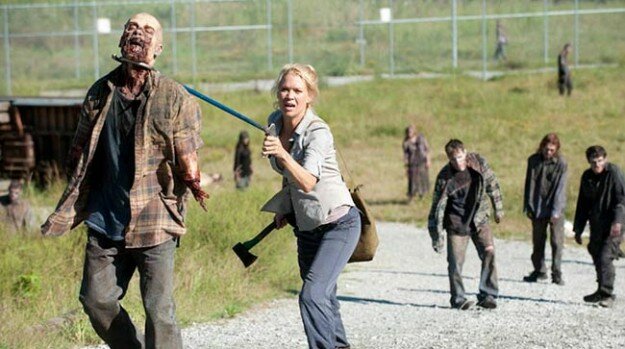
Episode 11 is less action packed than the previous and analyses the opposing groups as they plan out tactics for war. This is mostly an Andrea-focused episode as she becomes the middle-man (gender-specifications gone to hell there) between the two camps. Andrea has gradually turned into an iconic female-figure of the series but her worrisome tidings between either the Governor, Milton or Rick et al does make her somewhat dull.

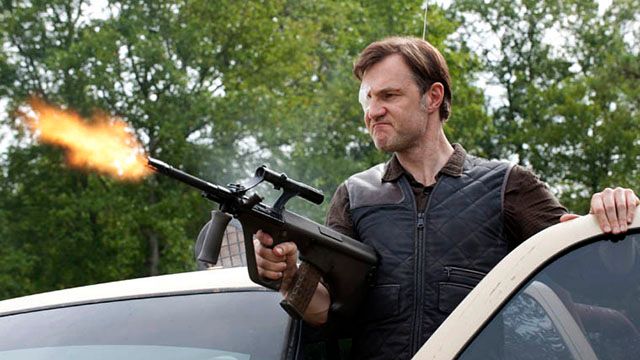
The Governor’s ultimatum to Andrea that if she goes to the prison, “stay there”, couldn’t be more desirable if a fan-boy started writing episodes. Andrea needs to be back with her original group so it’s unfortunate that as she quickly settles back in after travelling over, she decides to head back to Woodbury by the end of the episode. More disappointing is the Governor’s pull on her that a tried assassination fails – her plan to stab him in his sleep would end all the conflict (though, it would also leave The Walking Dead with little going on) and break his spell on her. Alas, the Governor lives for another day and another episode, surviving to add some more drama.
Adding tension in the prison is the inclusion of Merle. As Glenn understandably wants him out, Rick and Hershel see him as either useful or just simply tied to Daryl. Hershel is one to pacify the situation by talking to Merle one on one. In this scene we learn a little more about Merle, mainly his learned library lessons.  Momentarily, we see him as a neutral sort in amongst the crowd, offering his services to better the situation for his brother (and maybe the others if he’s found a new respect for them).

As Rick’s group has a crisis of opinions, the Governor’s army is building. The Tyreese-led group has left after Rick’s outburst and have found the company of Milton and Andrea. The former takes them back to Woodbury and they exchange words of hate for the violent Rick. It’s now a big band of aggressors versus our little troop of heroes.

“I Ain’t a Judas” is not a bad episode as everything in it is crucial for the development. It’s just a 40 minute exercise in exposition, however. Not as boring as some of Season 2’s episodes but certainly the most dialogue-heavy of Season 3 so far.

Maniac Review


Director: Franck Khalfoun

Writers: Alexandre Aja, Grégory Levasseur, C.A. Rosenberg


Starring: Elijah Wood, Nora Arnezeder, Liane Balaban, America Olivo, Sammi Robtibi, Joshua De La Garza

Synopsis: Frank (Wood) is the owner of a mannequin shop. His private life is made up of brutally murdering and scalping young women and attaching their hair to his private collection of models. One day an innocent woman (Arnezeder) comes to look at the restored mannequins for an art show, befriending Frank in the process but dangerously unaware of his psychotic alter-ego.


Elijah Wood has made it clear that he does not want to be solely remembered as a kind, loveable Hobbit all his life. During and after The Lord of the Rings trilogy he made a string of anti-Frodo films including Green Street, Sin City and Eternal Sunshine of the Spotless Mind. Sin City was the main game changer that showed off a very different side to him. Just after the release of The Hobbit: An Unexpected Journey, in which he reprises his role as Frodo Baggins, Wood returns to screens with a similarly caustically contrastingly role and film – Maniac.

The main issue with Maniac (and a pull for some critics and a push for its promotion) is a nearly- unbroken point-of-view shot that hides Wood away from the audience. We hear his voice and occasionally see his face in a reflection, but his talent at embodying that character is seldom seen. Kudos to the actor despite this though; he creates a realistically eerie horror character using mostly his voice.

As the original brought the audience closer to the killer’s mindset with a narration, 2012’s remake takes it to the next level with an utterly immersive design. The POV shot that makes Maniac appear like a FPS is handled with a decent amount of tact by director Franck Khalfoun. However, for some audiences it may be more disorientating than the shaky camera work of found-footage horror. Or, worse still, too involving for some (Maniac sets up each kill to make it seem as if you are part of it), and upsetting beyond comprehension.

The second – and last – point of praise for Maniac is frightfully realistic make-up and special effects. The scalping was gruesome enough in the original but with today’s standards the scalping shot never looked so (horribly) real. Helped with Maxime Alexandre’s cinematography (a talent seen with The Hills Have Eyes and The Crazies) the aesthetic and content of Maniac is, at times, powerfully unnerving.

The set-up and effects may not be the only aspects to confuse or unsettle viewers – the script and basic premise is never completely worked out. The reason for Frank’s serial killing is hinted at regularly though we never know the full extent of his reasoning. This wouldn’t be an issue with regular slasher flicks but for a film intent on exploring the mind of murderer, it leaves out more motive than it cares to address. 

Maniac's main strength may well be its weakness - an almost continual POV shot from the perspective of the killer that immerses you in the act of killing, yet drains the film of required tension. Knowing the whereabouts of the killer gives you very little to rely on when it comes to scaring the audience; it is the brutality that Maniac frightens you with, which it does pretty well. Wood is – when you can remember it’s him – pretty stellar. The remaining cast are banal clichés, written in with little effort or care. Try as it might to look and feel like a new cult classic (with a score that is desperate to be Drive) it will stay with you for a few hours after, but Maniac eventually becomes another forgetful modern horror. 


**
By Piers McCarthy. Also posted on LiveForFilms

Tuesday, 5 March 2013

Broken Review


Director: Rufus Norris

Writers: Mark O’Rowe

Starring: Tim Roth, Cillian Murphy, Rory Kinnear, Eloise Laurence, Bill Milner, Denis Lawson, Robert Emms, Zana Marjanovic

Synopsis: Chronicling the lives of three neighbouring families, mainly Skunk (Laurence), her dad (Roth), brother (Emms), nanny (Marjanovic) and her nanny’s boyfriend (Murphy).

British film may be most identified as “kitchen-sink dramas”. It’s by no means a negative perception of the country’s style and focus; it has been seen as such because it does it better than nearly any country. Broken is another entry in the British film catalogue that excels at what it’s doing. Portraying drama, humour, love and violence (especially in the same film) cannot always work tonally yet Broken resonates realism. Theatre director, Rufus Norris is, perhaps due to his creative background, a natural at presenting Mark O’Rowe’s upsetting story.

As well as the director there is another new addition to the film world – one Eloise Laurence, who shines throughout. Leading a cast of already well-recognised players, Laurence could have been overshadowed by actors such as Tim Roth or Cillian Murphy. However, often is the case she steals the scene from them, and a few others.

Broken’s greatest achievement is its ensemble who never hit a bum note in the 90 minute run. With actors playing rough, almost clichéd working class fiends, or mentally challenged loners, there is the chance that one would stand out like a sore-thumb – over or underplaying that particular role. This is never the case, and with the horrid Oswald clan or the jittery Rick character their casting has been carefully chosen to make their scenes stand out as much as the lead’s.

The atmosphere that the cast and crew have so skilfully created is, unfortunately, quite muddled at points. This is what leaves Broken from becoming a flawless film. Tonal shifts from dark, nightmarish drama to jolly, comedic antics are jarring when they switch so suddenly. This isn’t to say it undermines the realism as, of course, life is full of changes. But for what Broken chiefly appears to be (a “kitchen-sink drama”), moments of juxtaposition can clumsily contort the ambience.

The creation of the film’s mostly bleak mood has been masterfully arranged with a score and cinematography. Each household with its own identity and each character with a very distinctive personality – like any good mise-en-scene in film, it pronounces itself to make the actors and director’s job just that bit easier. You can see all the elements working together to make Broken as human and relatable as any typical drama.

Hopefully the average viewer won’t have experienced the violence shown in Broken but there is never a moment where it feels alien or over-the-top. In fact, the last 20 minutes of the film are so heart-pounding and probable that you are left emotionally drained. Edited with skill and directed with such precision, this is drama that has put British film on the map. Consider Lyne Ramsey’s Ratcatcher, Ken Loach’s Kes and, to a degree, Mike Hodges’ Get Carter and you know what to expect in terms of heart-break, an analysis of adolescence, and violence.

****
By Piers McCarthy. Also posted on LiveForFilms

The Walking Dead Season 3 Episode 10 Review


I labeled episode 4 of Season 3 “arguably the ‘best ever’” which I still stand by. However, in terms of the direction and editing of action, “Home” is superb. We pick up from the end of “The Suicide King” with Rick still hallucinating. One may wonder if it will become an episode dealing with the psychological trauma that Rick is undergoing; in a sense, it is. Whenever the scene focuses on Rick we are analysing his fragility, his strength and his sanity. 

The opposing Woodbury group are similarly shown in a meditative light to begin with; Andrea, Milton and the Governor under close scrutiny as to who is loyal. The Governor stays loyal to Andrea, promising her pacifism toward the prison group. Though, to the ever-wary audience, this just appears to be another one of his Machiavellian statements.

Cut to the newly formed third-narrative strand and Merle and Daryl are wandering the woods looking for food. This, at least for me, is what I wanted to see. Daryl is one of the best characters (if not, the best) character in the series and any chance of him disappearing would quickly sour the show’s sensationalism. And whilst seeing the two brothers up to very little is not everything we expect and desire it’s still better than nothing. Luckily, uproar and tension arrives with an isolated incident on a bridge with a group of survivors under attack from a hoard. In this brief but bloody scene Daryl shows off his independent, heroic, bad-ass persona – freeing the viewer from any worry about his future as a dullard double-act with Merle.


This scene’s violence and effects is top-notch and only a mere burst of energy compared to what’ll come later. One zombie drops to the ground, head by the wheel of a car, and has his head explode under the force of the tyre. It’s a small but excellent example of the effects team’s skill.

Balancing out the drama and action we return to the prison where Axel and Carol are having a friendly chat. This is the first instance where Axel’s character has been explored. He has never appeared malicious or unfriendly. The moment you finally say to yourself, “I’m liking this guy” his head snaps back with a sniper’s bullet. Sudden and completely unexpected it’s a bold move from the writers to kill off a character just about to be properly introduced. However, it was the case with Oscar and the original prison leader – dead within the space of an episode – and the no holds barred approach to story-telling is what makes The Walking Dead (and other hits including Breaking Bad and The Wire) so damn thrilling.

And so to the aforementioned action...

Axel falls, Carol lies behind his body; Rick, out in the fields trying to capture the Lori phantasm, leaps to safety under a bridge amidst the barrage of gunfire; the rest hide in the prison fortress, desperate to provide some cover fire. As unexpected as it seems, this is the Governor with a definite plan. With bullets aiming to hit as many of Rick’s group as possible, he adds walkers to the equation by driving a van through the gates and releasing a small swarm (followed by walkers surrounding the building). This has all happened within the space of two or three minutes and ends as quickly as Axel’s life. Speaking of Axel, the poor bastard is riddled with bullets as Carol shelters behind him – a weirdly noble sacrifice.


Just as each of our hero’s lives seem in dire jeopardy, the Governor leaves. Danger is not absent however, and the walkers still surround and invade the territory. No one is more vulnerable than Rick on the outskirts of the forest. He shoots and whacks his way through a few but looks surely to get injured. It’s here where the episode could likely end – leaving us with a spectacular cliff-hanger. Still, what happens next is even better. A close-up shot of Rick and a zombie’s gaping, biting mouth inches apart and then the beautiful sight of Daryl’s arrow piercing its way through the undead’s forehead. It is a moment of pure joy knowing our favourite has returned, and with such brilliant timing. Of course Merle is with him but in that moment it’s not an issue; just to see Daryl back where he belongs is divine.

The episode draws to a close with Daryl, Merle and Rick dashing back to the security of the prison walls. Nothing much needs to be said (that’ll be the next episode’s job), it’s a simple declaration of war.  

By Piers McCarthy. Also posted on Flickering Myth

Thursday, 28 February 2013

No Review

Director: Pablo Larraín

Writer: Pedro Peirano

Starring: Gael Garcia Bernal, Alfredo Castro, Nestor Cantillana, Antonia Zegers, Luis Gnecco, Alejandro Goic

Synopsis: During Chile’s 1988 referendum the Government implemented two advertising campaigns for a new election. It included a “Yes” and “No” cause for Augusto Pinochet. No focuses on the “No” campaign and one young advertising executive, René Saavedra (Bernal), and his method and work towards defeating Pinochet.

No may be a relatively small film – with low production costs and no star-studded cast – but it makes an assured impression. Tonally it’s quite unique, becoming a quaint political thriller/drama (not your average description of that type of genre).  However, the stand-out feature of the film is arguably its aesthetic – filmed with a U-Matic and looking incredibly old-school, No looks so different to the RED or 2K A-grade cameras of today that it immediately grabs your attention.

The seemingly archaic aesthetic, laced with blurred lines and crackly pixels, is jarring at first. Once your eyes adjust to the HD-free cinematography the style does, in fact, become unnoticeable and perfectly fitting for the capturing of the era and events.

Much like the advertising agenda of the film, No is very clever at hitting all the right notes in order for it to get noticed. First off, the lead actor, Gael Garcia Bernal, has a fantastic screen presence who perfectly embodies the everyman hero. Watching as he controls the advertising campaign (experiencing comedy, peril and romance along the way) is fascinating, more so due to the character being a young man in the company of tired, old officials. Under the circumstances of taking on an established power figure, Bernal’s character does find himself on the wrong paths; these scenes are particularly tense sandwiched between dialogue-heavy or (contrasting) comic moments. The aforementioned scenes of heavy dialogue are the only drawback to the film, leaving No to drag in certain places where action and rumination are mismatched in the narrative’s arrangement.

The light-hearted nature of No will be one helpful factor in generating a wider audience (along with its Oscar nomination). The theme song created for the “No” campaign will inevitably get stuck in your head for weeks and the general “kill them with kindness” efforts of the adverts shown will additionally remain memorable. Those not particularly interested in politics should be able to find something in No, whether it be the humour or the execution of the campaign. Because of what No aims to show you and the level of strangeness in the “No” operation, it becomes a striking film deserving of audiences and accolades.

****
By Piers McCarthy. Also posted on LiveForFilms

Monday, 11 February 2013

The Walking Dead Season 3 Episode 9 Review

Much to some readers’ consternation, I felt the mid-season finale of The Walking Dead’s third season wasn’t all that wonderful. It was still energetic, visceral and enjoyable (bettering the majority of contemporary television) but was noticeably poorer than the 7 episodes that had preceded it. Returning after a two-month hiatus, The Walking Dead still stands as one of the best programmes currently airing, but episode 9 is nonetheless overshadowed by the several seminal episodes.

Major Spoilers Follow

Season 2 was flawed by a bitterly slow series of events – a problem dealt with perfectly during the start of the third season. Whilst “The Suicide King” never becomes too sluggish, there are some issues with the pacing, mostly a decision to rush through events. Given the relatively long break from episode 8 to 9 airing, the best thing to have done is to take things steady with the action. I found episode 8’s Woodbury infiltration and escape frantically shot and edited, ruining some of the tension. The same can be said for episode 9 which starts off with Daryl and Merle pitted against one another in a fight to the death. This was the cliff-hanger clincher for me last December – something I was eager to see the result of – but takes a mere few minutes to end at the start of the season’s second half. Just a few more shots on the brothers’ faces (showing their turmoil/anger/fear) would have sufficed and brought a bit more drama to the set-piece.

Despite this, the second infiltration by Rick and Maggie brilliantly builds on the new “Rick versus The Governor” story arc. The Governor coolly walking through the smoke grenade’s smog is now the new iconic image of The Walking Dead’s conflict. It shows the possible end to Woodbury – a point lingered on for the right amount of time. The best piece of damning evidence to Woodbury’s survival is a gap in the gate, with a classic-looking zombie drooling and moaning before it.


With The Governor knowing of Rick et al’s hide-out, the prison may also become a doomed locale. However, before that happens there is still some change happening there to keep you interested. For one, there is the new group currently housed in the cell next to Hershel, Carl, Beth and Judith. They all seem pleasant and humbly concerned about their future with or without the prison lot. But one member changes your perception when he mentions knocking off Carol and Carl in order to get their guns. The leader, Tyreese, is shocked by the idea, yet it can’t erase the idea in the audiences’ mind that they may not be as innocent as they appear.

There isn’t much development with the new crowd that warrants immediate attention; all concern goes towards Daryl leaving his borrowed family for his blood one. Daryl is an integral part of the show – Rick’s right-hand man and one of the most beloved characters. As he trudges off with his evil brother there is a definite drop in the show’s credit (how it will last without Daryl or how they’ll bring him back is now a haunting question).

What marks the series as a well-acclaimed one is its ability to deal well with certain themes. The overarching ones will always be loss, survival and humanity, though each episode usually contains a specific one. Episode 9 looks closer at Rick’s madness and also the clashes between counter-communities (Woodbury and the prison). For the latter, there is a sense of the community degenerating – whether it’s the take-over of Woodbury with zombies or its people wanting to leave, or Daryl leaving Rick and co for the prison lot – showing a slightly mirrored image of decay. Rick’s tortured mind is a theme seen only in snippets since Lori’s death. As the episode finishes he looks up a Shakespearian-type ghost of Lori, cloaked in shadow on the upper floor of the cell. As a programme continually promoting horror or scares, this is one of the most upsetting images to date. Not only does it reveal Rick as a broken, disillusioned man, it also draws on paranoia and phantoms – prime material for creeping you out.

By Piers McCarthy. Also posted on Flickering Myth

Friday, 8 February 2013

Holy Motors Review

Director/ Writer: Leos Carax

Starring: Denis Lavant, Edith Scob, Eva Mendes, Kylie Minogue, Elise Lhomeau, Michel Piccoli

Synopsis: A day in the life of Monsieur Oscar (Lavant), a man travelling in his limousine to a string of “appointments” where, in each, he takes on a new identity and agenda.

One of the leading film critics, André Bazin, titled a series of essays “What is cinema?” (“Qu’est-ce que le cinema?); it was, and still is, a question of great debate and discussion. Often, when looking at the meaning of film the subject itself becomes introspective. From the glitzy, comic reflections of Singin’ in the Rain, to the topic of the viewer in Cinema Paradiso, or the surreal machinations of narrative and characterisation in Holy Motors – cinema continually draws attention to its own workings and effects.

Leos Carax’s Holy Motors is arguably one of the oddest films (not only in terms of its style, but in general) of late to instigate examination. Like most art-house films this is a film that will thrill some whilst alienate others. Its premise is never completely explained – nor seemingly concluded upon – leaving some fascinated long after watching it, or annoying others with its ambiguity.

Whilst it’s understandable to consider the latter, it is the former that is truer in Holy Motor’s evaluation. The presence is simple to explain, more difficult to assess – a man’s odyssey through Paris serving “appointments” in different guises, for a reason relatively unknown. It is a joy and challenge to watch; it cries for a studious analysis that would add to your wonderment.

Denis Lavant in the lead role is astonishing. He is predominantly named Mr. Oscar yet is a man of many names and faces. As he puts on his make-up and costumes he totally transforms himself. You can never completely know the character(s) he plays but Lavant never makes them too mysterious or too distant either – in every one he adds a nuance to the performance to generate audiences’ engagement. His acting abilities are wonderfully on show here, with none of the supporting cast getting the slightest bit close to stealing the show.

The 8 and a half (possible reference to Fellini’s 8½?) appointments he goes to are excellently enigmatic. Some scenes are aesthetically great (the motion-capture dance is one of the best scenes of film 2012) and some are curiously captivating (the crazed hobo and doppelganger hit-man being two brilliant bits). Not all are that interesting and the much-required second viewing may have you smiling at the anticipation of your favourite segment or sighing at the prospect of another.

Holy Motors is a wholly weird film laced with cinephilia. It will appeal to the cine-literate crowd and perhaps misunderstood by the average filmgoer. In whatever case, it still deserves a watch just to expand your appreciation of imagination and storytelling. Carax never gives you a straight answer to what it’s all about though it doesn’t really matter; you will never forget at least a third of the film for its sheer insanity.

**** 
DVD Extras: Excellent hour-long interview with director Leos Carax. Deleted Scenes that should remain ignored as some ruin the allure of the final film. Basic trailer. ***


By Piers McCarthy. Also posted on Flickering Myth