Thursday, 4 April 2013

The Expatriate Review


Director: Philipp Stolzl
    
Writer: Arash Amel

Starring: Aaron Eckhart, Olga Kurylenko, Liana Liberato, Neil Napier, Garrick Hagon, Alexander Fehling

Synopsis: Ben Logan (Eckhart) and his daughter, Amy (Liberato) started a new life in Belgium after Ben’s job sent him overseas. He’s moved past the struggle of moving abroad and is at the top of his game with work. However, one stolen document leads the company into disrepair and Ben’s life is shattered; he and his daughter have to fight to stay alive once the conspiracy threatens everything.

Never underestimate the influence of a franchise; they may spawn a dozens to hundreds of similar films, setting the bar high, with not everyone able to improve on it. With The Expatriate it’s the opening with a John Powell-esque score and location subtitling that immediately harks back to Bourne. Replicating such a respected set of aesthetics and features from one of the best spy series in film is a bold move. And whilst both Expatriate and Bourne begin with some action or mystery, it’s only the latter that strikes the perfect key.

Arash Amel’s writing is relatively dull, and the crucial emotional relationship between Ben and his daughter is never all that special. It leads to a hum-drum state of affairs where you are never connected with the main characters. This problem gets exceedingly worse as the plot unravels superfluously and time drags on – by the end you have incentive to care about anything or anyone.

One notable aspect of the film is its hand-to-hand combat, nearly always appearing realistic. For a film not under the restrictions of a 12A/PG-13 certificate, or let loose with an 18 certificate, the violence is handled perfectly. Certain gun wounds, punches or tackles are felt as they’re unleashed – and never lingered on or cut away from awkwardly.

An overly-long example in the CIA/corporation-does-bad genre with moments of great action. Eckhart should not become the new action hero and The Expatriate reminds of us of his skill in dramas and punchy political parodies (if you haven’t seen Thank You for Smoking do so ASAP). Meanwhile, his co-star Liana Liberato (who was terrific in Trust) has no chance to show off her talent with the two-dimensional stock character. It’s a forgettable, occasionally entertaining, B-movie that does no favours for the cast and crew but will once again prove stunt-coordinator Frédéric Dessains’ expertise in his profession.

**
By Piers McCarthy. Also posted on Flickering Myth

Monday, 1 April 2013

A Late Quartet Review


Director: Yaron Zilberman

Writers: Yaron Zilberman, Seth Grossman

Starring: Christopher Walken, Philip Seymour Hoffman, Catherine Keener, Mark Ivanir, Imogen Poots, Wallace Shawn, Liraz Charhi

Synopsis: A well-established string quartet begins to suffer some setbacks after one member is diagnosed with Parkinson’s and the others get mixed up in love and affairs.

Given the names on the film’s cast list there’s little chance of A Late Quartet being badly-acted. Whilst they’re not the best characters each actor has played, there is a flawless quality to their performance. Christopher Walken, who in the last ten years has often exaggerated his persona in comedy, is the star of this film. He isn’t given as much screen-time as the rest – and not nearly as much drama – but his arc is quietly melancholic which has a much more profound effect on the film’s emotion. One scene where he reflects on his life and his losses during a sombre piece of music powerfully reminds you that he is a deserved Oscar-winner and acting icon.

The three remaining quartet members are similarly fantastic, given story-lines to eat up in all their critically-acclaimed glory. You are constantly reminded of the need for cohesion in this type of group and so watching as they break apart is expectedly dramatic. Whilst Walken’s character poignantly ponders over his aging and disease, the other three wrestle with love and control in the ranks of their quartet. It is, as you imagine, a variety of tearful arguments, physical clashes and loud yelling. They all know how to deliver these moments with the exact amount of intensity and prowess, making A Late Quartet seem like a classic melodrama.

They all handle their characters wonderfully, making them seem as real as the actors’ practice with their chosen instruments. Only on occasionally do you see the film slipping into clichéd territory, and at these points you feel slightly cheated (as if Hollywood producers felt compelled to bring some familiarity to the floor). The film is a long, dialogue-heavy meditation on support and collapse but it feels mature in its ability to do that without too many truisms of the genre.

A deft exploration of relationships and life, coupled with the interesting focus on a tight quartet group, makes A Late Quartet very touching. Its focal point of the quartet and Beethoven’s elaborate Opus 131 will not make it a box-office behemoth, though for its chosen demographic it will certainly affect and entertain.

****
By Piers McCarthy. Also posted on LiveForFilms

The Walking Dead Season 3 Episode 15 Review

It’s the penultimate episode of The Walking Dead’s third season so expect – and be excited by – shit going down.

Major spoilers ahead

As Andrea has been cruelly locked away, the person the Governor still pines after for torturing is Michonne. Having negotiated with Rick, plans for peace could be achieved with Michonne being handed over. This is episode 15’s main story arc and the device creating tension and unrest amongst the group.

At the centre of “This Sorrowful Life” are Rick, Daryl, Merle and Michonne. The latter being the MacGuffin of major events and the victim of a divide of ethics between Merle and Rick. One discussion between Merle and Rick tells us more about the Southern sadist, as he’s welcomed to the “inner circle”. Merle is becoming an interesting sort and his overall persona is still unclear; is he a villain or a decent man? The first half of the episode shows the former, more regular, side to him as he kidnaps Michonne himself. He believes Rick will quit on the idea of handing her over and decides to take it upon himself.

Merle then becomes the main focus of the episode – with each of his closest associates talking about him, or taking action against or alongside of him. First to the floor is Glenn who stills remains vehemently against him, advertising the notion of his mean nature to Daryl. Daryl, then taking on board the facts, talks to his beloved brother – the two contrasting personalities of blood relation has been one of the finer elements of The Walking Dead’s character relations. “I just want my brother back” is how Daryl articulates his opinion to Merle, a statement that will become truly poignant by the end. The emotion that develops between each the episode’s intrinsic characters is sublimely executed through the writing and acting, with Rick and Daryl eating up most of the scenes.

Speaking of eating, episode 15 contains something we've not seen in a while - the disembowelment and consumption of a live character. No one important ends their run in the programme and it's only the Governor's minions who suffer the terrible fate. It comes after Merle and Michonne travelling out to Woodbury for the abovementioned handing over of the female warrior. During a stopover to obtain a new car the vehicle's alarm sounds and brings forth a sweep of walkers. Michonne, tied up and rather defenceless, kills one with the heel of her boot, and shoves another away until Merle (unaware of the hoard with the alarm sounding whilst inside the car) almost gets bit and gets the both of them out of there. As Michonne and Merle chat on the drive away she imparts some wisdom about Merle’s opportunity to redeem himself. As the character has slowly started to signs of this, he lets Michonne go and moves ahead by himself.


With Daryl still searching for Merle he stumbles across Michonne who explains he let her go – leading Daryl to chase his soon-to-be-deceased brother. Merle’s plan is as follows: attract a load of zombies with loud music, drive into the abandoned factory base and wait for the Governor’s men to wander into the chaos. When they arrive he pops shots over the other team’s, managing to kill a few henchmen without getting noticed. Sadly, the newly-noble character is found, beaten and left for dead by the angered Governor.

Before the final cliff-hanger we return to the prison where Glenn proposes to Maggie after talking with Hershel. Also in this brief part is Rick gives a rousing speech about his relationship with his team/family and his loyalty to them all that can and never should be compromised. “We are the greater good” he asserts – one more intrepid description of The Walking Dead’s main troop. 

Episode 16 ends with the aforementioned showing of zombies shredding henchmen to pieces and then chewing on their corpses. It’s a classic image of zombie-related fiction and is this week’s best bit of blood-lust. Daryl is the one who happens on the scene, killing the few biters. Shooting one dead, he moves on to another chewing away on one of the Governor’s men, staring hard at it he realises it’s Merle. Much like when Rick discovered Lori had died, Daryl’s reaction to the loss of a loved family member is exceptionally sad; more so because we love Daryl and see his gentleness behind the tough exterior. As he wells up with tears it’s very difficult to fight them off yourself. The pair tussle as one goes to bite and the other has nothing but sadness and confusion running through his mind. Daryl then goes mad, thinking of what he has lost and what could have become a stronger and more heartfelt companionship, stabbing Merle’s skull again and again. It’s a moment of raw intensity and Noman Reedus is terrific at portraying the unmitigated grief.


We will now have either a broken Daryl or an enraged, unstoppable Daryl. My money’s on the latter but in any case, the finale should hopefully be awash with emotion and action.


By Piers McCarthy. Also posted on Flickering Myth

The Walking Dead Season 3 Episode 14 Review


Much like “Clear”, Episode 14 of The Walking Dead focuses on a specific story arc.  The third season is heavily reliant on the conflict between Rick and the Governor, and since we know a great deal about Rick already, the writers are developing the Woodbury foe with terrific care.

Major spoilers follow

Of course, at the moment, any spotlight on the Governor involves his right-hand-man, Milton and his lover, Andrea. The latter has slowly been edging herself away from the eye-patched menace, seeing his Machiavellian ego for all its worth. So for a lot of “Prey”, Andrea is the centre-point.

We start off, rather bizarrely, with a flash-back to Andrea and Michonne during their time together. The question of who the two jawless, armless, chained-up zombies are is something we as an audience have wanted to know for a while. Still, in comparison to the rest of the episode, the flashback and its content barely matches the tone and theme of the episode. We are finally told that they were people Michonne once knew, and not people she liked it seems. The other quick scene before the credits start up is of the Governor preparing a torture chamber (and enjoying it a little bit too much).

Audience’s concerns about the Governor’s “sanity” have been there from early on. Now it’s Andrea, and even Milton, questioning his morals and his actions habitually. Showing Andrea the torture room from a space above, Milton implores Andrea to tell the prison group to leave before war and in time, the Governor will move on. Andrea is more adamant about killing him, however, and we witness another perfect set-up for just that. As the Governor works beneath them, Andrea aims her gun at him. We know that the chances of him being killed this unassumingly are slim so the tension is never quite there in this moment. But, the interaction with Milton does add something to the scene; he still protects “Philip” but also considers the ramifications of Andrea’s decision.

Andrea understands Milton’s apprehension and leaves on her own (before confronting the newbies who want no trouble and let her pass). Andrea out on her own is an interesting choice of direction for the episode as we haven’t had much chance to follow her singularly since her entering Woodbury.

The friction between Andrea and the Governor lurks under the surface of their face-to-face interaction but as this episode shows, it’s about to become truly unmistakable. After she leaves the Governor starts asking questions about where and why. Milton is one such person questioned – his answer of knowing she was leaving finally erodes their friendship, with the Governor aggressively pinning Milton up against a rail.

The hunt begins after Andrea departs – the Governor seeking her out himself and Caesar showing the new lot the ropes. Tyreese and co are a pretty dull bunch, in all honesty, and their spats and discussions bring hardly anything to the show. Tyreese is the strongest character out of them but only due to some discord with Andrew Lincoln 2 (Daniel Thomas May – a southern accent and deranged mind away from being Woodbury’s Rick). Fortunately, not so of the episode is devoted to their story and we cut back to Andrea, the Governor and Milton.

Andrea on the run contains one of the best moments of The Walking Dead, but not before a clichéd crack at some scares. Dodging the Governor’s car by running into the woods, Andrea leans back on a tree with no apparent danger in sight. Out pops a walker’s arm followed by two other walkers walking over. It’s not a terrible piece of action, but just too formulaic for the maturity of the show. However, it may have been an excuse for some weekly blood-lust which it provides once Andrea stabs the zombies and snaps the arm of the walker behind her.


Some may find the next scene slightly familiar (No Country for Old Men, anyone?) but it still creates quite an atmosphere of dread. The Governor hooting the horn as Andrea runs for her life is a strange action, calling her out like a madman. Nothing compares to the following chase – arguably one of the series’ finest moments.

Looking and sounding like a scene from Halloween (with Jonathan Ortega’s chilling composed music), the eight-minute hunt is superbly directed and acted. The Governor may still be out of harm’s way for the season’s climax (expectedly) but Andrea’s fate is not certain. That’s why her creeping around the factory, cautious of not making any noise and escaping biters along the way, makes your heart pound.

It’s almost too wonderful not to need analysis but if anything has to be said, Andrea’s escape is fantastic. Opening the door onto herself (and therefore protecting her from any walker’s contact) and letting a flood of walkers come in through an adjacent room into the Governor’s path is such a crowd-pleasing instant. He fires off rounds of ammo and thwacks the skulls on the oncoming hoard and is left to fend for himself.

Andrea finds the prison and is almost caught in the sight of Rick’s scope. That’s before the Governor grabs her and pulls her down (confusing poor old Rick, leading him to think it’s another hallucination).

The penultimate scene shows the walkers who have been trapped by Caesar and his crew being burned in a blazing fire. It could either be Tyreese (who expressed distaste to the idea of using them as weapons), but it’s most certainly Milton. This is his way of getting back at his old friend – and after questioning a naive Tyreese, the Governor knows it’s his spectacled companion. So for Milton, the end could be near.
Speaking of end, the last shot we see is Andrea tied up in the Governor’s formidable torture room, giving us another brilliant cliff-hanger.


By Piers McCarthy. Also posted on Flickering Myth

Thursday, 14 March 2013

The Walking Dead Season 3 Episode 13 Review

Two fierce, angry men are planning war against one another. Both have a team of loyal and dedicated soldiers ready to fight the opposing side. As well as this rivalry, there is a seemingly never-ending hoard of the undead that always need to be getting the sharp end of each side’s sticks. The social politics of The Walking Dead has continually been the backbone of many of its episodes, though for episode 13 it’s undeniably obvious.

Major spoilers follow

David Boyd, television director/cinematographer, whose work includes Deadwood and Firefly, clearly understands the cool aesthetic of the Western genre. That’s why “Arrow on the Doorstep” begins like a fine Leone film. This comparison, albeit, is only minor as it is mainly the first four minutes that capture the silent, multiple angle set-up of the Spaghetti style. Nevertheless, it builds up a dread that all great Walking Dead episodes need to have. Rick tiptoes through an abandoned barn whilst Daryl and Hershel watch guard from the outside. We don’t understand what they’re up to until Rick comes eye to eye (no pun intended on the cyclopean villain) with the Governor. Cue creepy credits.


So just who is the bigger man in The Walking Dead; the boss/the alpha male/the don? Almost the whole of this episode looks at this query – with Rick and the Governor sitting down negotiating matters of territory and brethren, Daryl and Caesar showing off their slaughtering skills, and Glenn and Merle shouting and sparring. For Rick and the Governor it’s a subdued cock fight with words and reasoning being used as the figurative swords. We all side with Rick but we also understand the Governor’s desire for Michonne being handed over – after all, she did “kill” his daughter and leave him with one eye.

“One woman worth all those lives in your prison?” is a rational question to be asked, and in all honesty it’s tough to decide on whether Michonne is. On the one hand, she’s a kick-ass fighter and on the other she’s a mysterious, unreadable member of the group. Still, as Hershel says at the end, she saved a lot of the groups’ lives. Rick tells everyone he will go to war (never mentioning the Michonne-bargaining to anyone but Hershel) but only wants to be talked out of it. Could part of being talked out it lead to Michonne’s handing over; Hershel and his daughters’ lives in jeopardy over one newcomer? That’s a development that’ll make the next few episodes very interesting.

As well as our hero and villain in disagreement, their human side-arms are similarly quarrelling (though just as respectably). Daryl and Caesar showing off their walkers killing technique is peacocking of the highest degree, but for no woman. Andrea is present (before she rolls her eyes at them and leaves) though it’s a test to see who has the better slice, whack or stab when it comes to killing zombies. Daryl obviously wins and earns Caesar’s respect as the two chat post-rumble. As it is with Rick and the Governor and Milton and Hershel (discussed soon), it is the discussion of loss that breaks the tension between the two enemies (even if only briefly).

Milton and Hershel are the two that connect the most. Milton is ingeniously collecting notes on the events of the apocalypse for future generations to look back on, something that Hershel (and most of the audience will) find endearing. Milton’s avid curiosity about the time of infection, amputation and healing of Hershel’s amputation breaks the ice, with an additional quip from Hershel. As men of medicine, here is a pair who would be a great duo were it not for the divide of colonies. It’s something that might develop later on (perhaps if the war is won by Rick, Milton may join with them).

As the two parties separate after lengthy discussion – to be resumed again at a later date – the episode ends with a juxtaposed feeling of divide and familiarity. Talk of war may be exciting for the action-loving audiences but as Rick mentions, it’s not a sought-after outcome (especially now that they have all talked with one another). Maybe war will not come and The Walking Dead will throw another curve-ball. As of now, we have our heroes on edge at the prospect of battle – “They need to be scared...’cause that’s the only way they’ll accept it” as Rick tells them. He’s right in a broad sense; not all of them are intent on risking their lives but if it is the only way, that’s what needs to happen. That’s a common theme of the series – the last resort – and the viewer continues to ponder over the extent/limit of it. 

By Piers McCarthy. Also posted on Flickering Myth. 

Wednesday, 13 March 2013

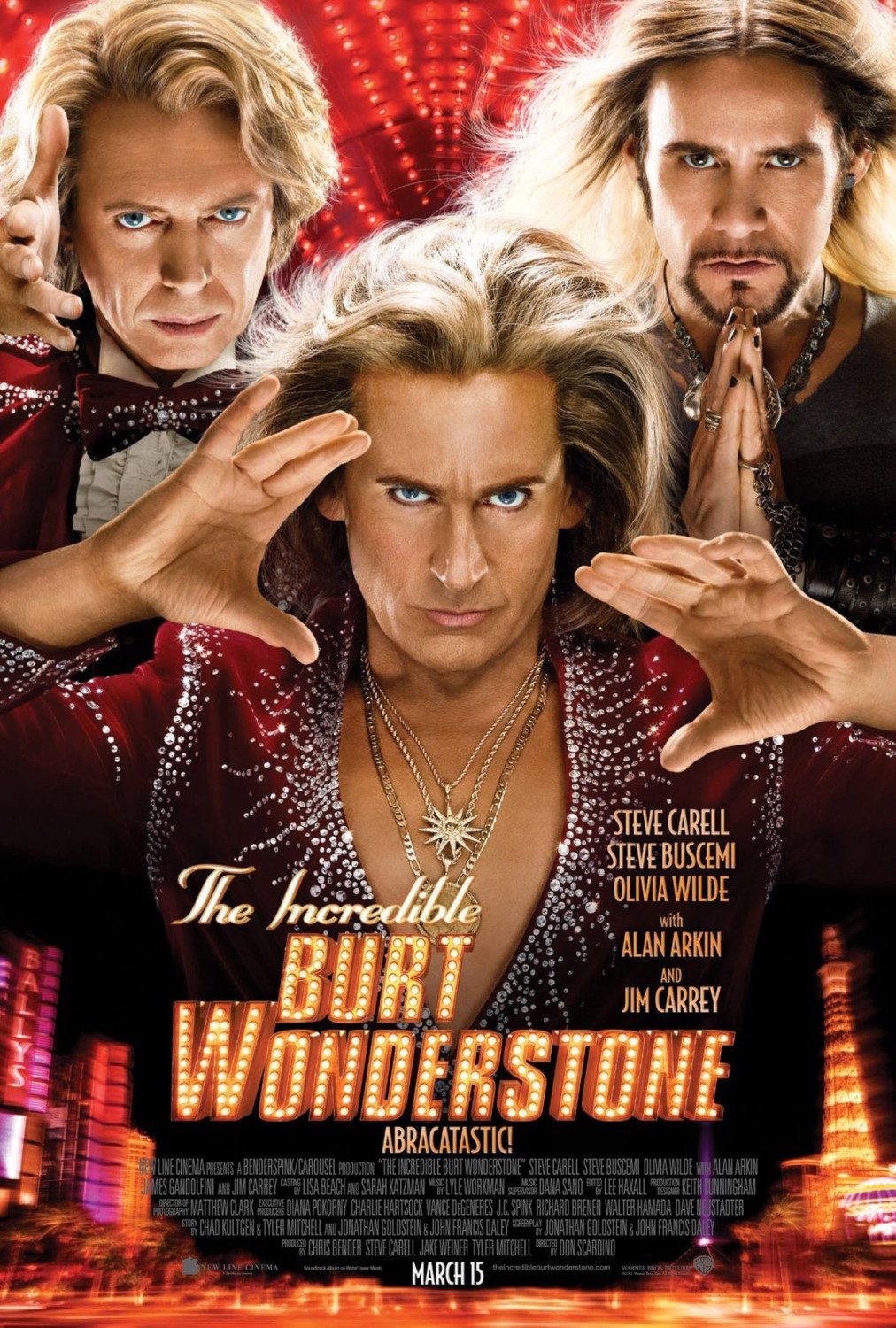
The Incredible Burt Wonderstone Review


Director: Dan Scardino

Writers: Jonathan M. Goldstein, John Francis Daley

Starring: Steve Carell, Steve Buscemi, Olivia Wilde, Jim Carrey, James Gandolfini, Alan Arkin, Jay Mohr

Synopsis: Burt (Carell) was never a popular boy at school and neither was his best friend, Anton (Buscemi) but together they used magic to find happiness, and worked so hard that they became a hit Vegas act as adults. However, after many years doing the same act friction is developing between the two and hot new magician Steve Gray (Carrey) is jeopardising their hopes of an ongoing career.

Comedy of the last century has been mainly irreverent and extremely adult. The Hangover, Superbad and Bridesmaids are all the polar-opposite of family entertainment. The other lot of hit comedies have been mostly irrelevant; 12A releases like Little Fockers, Grown Ups and Mr. Popper’s Penguins. That’s unfortunately one of only ways to categories successful comedy cinema of late – a collection of cheap or crude clowning around. The cast and premise of The Incredible Burt Wonderstone looked as though it could change things up somewhat but it sadly reiterates everything that’s wrong with contemporary comedy.

Starting off with a clichéd set-up of Burt Wonderstone’s youth (bullies chasing him home, an uncaring mother and a nerdy kid as his only friend) does the film no favours in making it seem fresh. The only stand-out aspect of the opening is a beautifully surreal piece of casting with Alan Arkin as a famous 80s magician introducing his “how-to” magic video on Burt’s TV. Arkin will later settle into his familiar grouch persona but his briefly jubilant and over-the-top acting (perhaps only funny to those aware of Arkin’s persona outside of the film) is amusing.

As cruel as it is to criticism the child actors, these particular two playing young Burt and Anton are beyond awful, hamming it up (maybe under Dan Scardino’s direction) to within-an-inch of the film’s “life”. As the film moves into present day, with Carrel and Buscemi, it’s a slight relief to have the children gone. Nevertheless, despite Carrel and Buscemi as the leads, they are equally terrible. Carrel puts on an incredibly forced deep voice (a characteristic better suited to Will Ferrell) whilst Buscemi quietly reads through his lines, none of which enable him to get a laugh.

With a cast as hilarious as this it’s a profound shock to see everyone doing so badly. Jim Carrey occasionally delivers a quip or performs a comically contorted face, bringing some humour back, but these moments are few and fleeting. Carrel and Carrey back together again after Bruce Almighty was a definite selling point but something about how the characters are written leaves you wanting to see none of them. Burt is a bastard throughout most of the film and so is Grey; the only difference between them is that the former redeems himself (though even then he still appears fairly cold by the film’s joyous end*).

The funniest scene (and it really does get the entire audience howling) is in the last 5 minutes. In most cases this would be a fantastic way to end a comedy – going out on such a high – but instead, it reminds you of just how unfunny the last 95 minutes were.

The Incredible Burt Wonderstone brings dangerous attention to the tawdry aspect of performance and showmanship. Burton and Anton's show is funny because it's terrible; captured so well because we are looking at it from within a poorly-constructed presentation (an Inception-esque exercise in criticism). The irony of the title is so well-pronounced - it's a critic's dream tool.
**

*I would have added a spoiler tag but the film is so predictable you know the course of its narrative from the get-go.
By Piers McCarthy. Also posted on LiveForFilms

Monday, 11 March 2013

The Walking Dead Season 3 Episode 12 Review


Often in assessing The Walking Dead I forget about the scale of the show; mostly I look at the writing and the direction, but rarely the design and set-pieces. Watching episode 12 was wonderfully eye-opening for immediately drawing my attention what I usually forget about it.

Major spoilers follow

“Clear” is a fantastic return to a singular narrative strand. It’s not often that the various stories are diluted down to a particular character or small group, so episode 12 feels nicely refreshing. What’s more, it also brings us back to Rick, Carl and the late Lori’s hometown.

Before we reach the long-left homeland of Rick and family, we are taken on the journey there. The car ride consists of a fretful Carl, worried about Michonne’s company, and a hysteric hiker yelling for them to stop the car and pick him up. I was excited to see a new, loner figure emerge in the chaos of The Walking Dead’s world as I always welcome a new story and character (the world of the graphic novel/TV series must be exceptionally rich for possible stories). Sadly, he’s ignored as Michonne speeds on by him. Afterwards, Carl, Rick and Michonne find themselves slowing and sticking in a road collision site, a muddied track keeping them momentarily static. There is then a sudden zombie attack but it’s quickly over. Two exciting elements are introduced – a new character and a hairy fight – but quickly deserted, leaving me entertained but also disappointed at lost story and action opportunities.

We then enter King County and your mind and eyes are rapidly attuned to detail. The detail of props and set-design is astounding – the place is littered with graffiti, signs, animal cages, and defences rigged up. The police artillery barracks has been raided and only a pile of burned bodies shows for walker-action. In a few minutes an overwhelming sense of history is created.


“It looks like somebody’s already made this theirs” says Michonne. It certainly appears that way and whoever is behind the odd DIY fortification has clearly spent some time securing their home. A zombie then shuffles in, showing some “life” to this silent town. As they go to kill the walker a bullet shatters its skull and our heroes are quickly alerted. The gunman demands they leave, sans weapons. Of course, Rick having come all this way to fortify himself for the Governor is not going to leave with fewer guns then he started with. A worrying bullet ballet happens but it’s eventually Carl who shoots the assailant, revealed to be none other than Season 1’s Morgan.

And so our interest is fired up to 11. They bring him back to his fortress – a home with more traps than Home Alone and Skyfall combined. Inside are the guns, a ton of them (“He’s been busy” is an understatement, Rick). Grabbing all they need – and more – Carl and Michonne set off to find a family photo of Carl’s. Left with the unconscious body of Morgan, we’re expecting a great reunion. Noting, however, the message-covered walls, Morgan’s mind may not be all it used to be (and with a son who has “turned”). Waking up he is crazed and confused. A brief tussle and Rick finally gets him to the point of reminding him of old times.

Lennie James as Morgan was a brilliant actor to start off the programme – another Brit who was making a grand and impressive entrance into mainstream American TV. Leaving him was a huge loss but having him back is a fantastic surprise. Having a lot to play with, in terms of character, James steals the show. The two men whose minds are not all there is a dangerous combination, but they balance out each other well. Rick, for the time being, has to return to “normal” in order to calm Morgan and we see Andrew Lincoln as the head-strong hero we love him for. It’s a stirring episode hearing about Morgan’s huge loss, loneliness and lunacy. Cries of anger and sadness are not uncommon in this programme but when paired with a cared-for character (like Rick when he found out Lori was dead) it makes for teary television.

Meanwhile, Carl’s desperate attempt to get his family photo from a zombie-infested restaurant gives us a bit of action and gore.  Using Morgan’s traps they distract the walkers, but only for a few minutes as one of the rat-traps open and the undead follow the scurrying vermin. Michonne uses her sword skills and we see bursts of blood and decent effects (enough to satisfy the action-adorers). As he and Michonne fail to quietly and safely enter, Michonne then goes back in and emerges with the sought-after photograph. Carl finally sees the good in her, and her place in the group has been cemented (as Carl reiterates at the end of the episode).
“Clear” finishes with Morgan choosing to stay in his kitted-out habitat. It’s a shame he couldn’t have joined Rick but two damaged minds would certainly jeopardise everyone. It also adds to the poignancy of the episode leaving Morgan with the ghosts of his past – a theme repeated with Michonne mentioning how she used to talk to her dead boyfriend, in a conversation about Rick’s ghoulish hallucinations. 

A really tremendous episode that has everything going for it – A-grade writing, acting, direction and design. Now with all the guns and ammo taken we can expect an epic war to be fought, though I hope the writers don’t forget smaller stories such as these as they are expert examples of engaging television.

By Piers McCarthy. Also posted on Flickering Myth