Wednesday, 21 August 2013

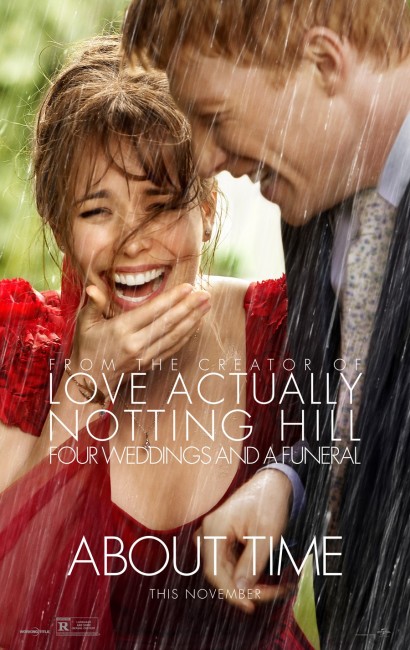
About Time Review


Director/Writer: Richard Curtis

Starring: Domhnall Gleeson, Rachel McAdams, Bill Nighy, Lydia Wilson, Tom Hollander, Lindsay Duncan

Synopsis: Tim (Gleeson), a quiet, timid 21 year-old lives a mundane life with the notable lack of a girlfriend. Things begin to take shape once his father (Nighy) reveals the family men are able to travel through time. Tim quickly uses his inherited power to discover more about life and, most importantly, to find love.

Richard Curtis has long since departed from snappy satire in the form of Not the Nine O’Clock News and Blackadder; now associated with strings of soppy romantic comedies. Yet, whilst his seminal television work feels like a distant, beloved memory for some, there are others more than happy with his Four Weddings, Notting Hills and Love Actuallys. He has an honest and indefatigable passion for the theme of love that, for the ones who pine to see and feel it, makes for some entertaining films. About Time, his latest rumination on love – with added time travel to mix it up a bit – is quite wonderful. Whatever flaws the film holds are, in the end, nearly forgotten thanks to Gleeson, McAdams and Nighy and a touching exploration of a father/son relationship.

Domhnall Gleeson as the protagonist Tim makes a strong debut in this genre – much like Hugh Grant did way back in 1994 with Four Weddings and a Funeral. Without a hint of his thick Dublin accent, Gleeson embodies the bumbling, shy Brit character perfectly. An everyman in his appearance and personality, he quickly establishes a familiarity with the audience. The same can be said for the film’s opening – a brief introduction of the Lake family. Here Gleeson and Curtis’ script portray the normality that makes the English rom-coms so accessible from the get-go.

With the pleasant English countryside and genial family members spotlighted the film then moves on to its hidden card in its cuff – the main character’s power to travel through time. Time travel has been continually tricky to pull off effectively in film and television and for About Time the errors and ellipsis still remain. However, Curtis has ignored some rules and added some of his own – the apparent lack of the Butterfly Effect but with certain restrictions concerning genetics. As Tim so often states, his abilities are often left by the way side in favour of living in life’s moments. About Time merely uses the time travel element to highlight the importance of “now”. When Tim flashes back and forth through his life it’s generally interesting and enjoyable but most appealing is his damnation of re-living events and focusing on the unknown future and a second-by-second existence.

With a strong core message the film is genuinely uplifting. Its other agreeable quality is the band of main actors. Gleeson is, as mentioned, a great screen presence with an innate charm and wit (aided by Curtis’ own pen). To know nothing about Gleeson and McAdams and to see only them holding hands would be tough to imagine; not that certain people can’t be matched but they do appear leagues apart. Original casting had Zooey Deschanel as his love interest – a choice that whilst agreeable would not hold a candle to Rachel McAdams. McAdams is one of the most divine women of contemporary cinema – down-to-earth and gorgeous. Nevertheless, personality and voice blend tremendously together and there is never a moment where you question their pairing. Third billing goes to Nighy as Tim’s father. He initiates the narrative by telling Tim about his gift – a scene that should be laughable and unbelievable neatly written and acted. Nighy is Curtis' lucky rabbit's foot, continually adding worth to each film he's written into. Whereas you'd expect McAdams to generate the film's emotion, it's actually Nighy who earns that role, brilliantly molding the film from behind the curtain more or less.

As much as McAdams lights up the screen, the film shifts from her focus to that of Nighy and Lydia Wilson’s tragic sister. This switch happens two thirds of the way through, turning the film from a romantic comedy into a heartfelt drama. Some may dislike the jarring change though they may be the ones not completely invested in the humanity of the story. Tim and his father share a bond commonly seen in families, with the added time travel skill that draws them closer together; sharing that much they have a beautifully strong relationship. By the end when time travel starts to prove difficult Tim spends more time with his knowledgeable Dad, there is a narrative crux that triumphantly brings tears to the audiences’ eyes*.

The beauty of family, life and love are profoundly explored in some of About Time’s runtime. The fun time travelling element may not be used as regularly in some viewers’ opinions though to see beyond that is the film’s most precious attribute. It’s heart-warming and smooshy, sure, but it’s also poignant and sincere. Most definitely the year’s best romantic comedy and (if it’s to be believed) a delightful directorial sign-off for Curtis.

****
  
*There weren’t many dry eyes in the screening I went to
Also posted on LiveForFilms

Tuesday, 9 July 2013

The World's End Review


Director: Edgar Wright

Writers: Edgar Wright, Simon Pegg

Starring: Simon Pegg, Nick Frost, Rosamund Pike, Paddy Considine, Martin Freeman, Eddie Marsan, David Bradley

Synopsis: Gary King (Pegg) assembles his childhood friends to reattempt an epic pub crawl in their hometown. However, upon getting there they discover the town has been taken over by aliens and the only way to go unnoticed is to carry on their crawl until they reach The World’s End.

Topping Spaced must have had Simon Pegg, Edgar Wright and Nick Frost full of trepidation to begin with. With their innate comic sensibilities, however, that worry didn’t last long once The Good Companions came up with Shaun of the Dead. The success of Shaun – from commercial, critical and global appreciation – then made the prospect of a second film quite daunting. Hot Fuzz, as it came to be, was not as wonderful as Shaun of the Dead or Spaced but it made for an entertaining two hours, with a final 30 minutes that was plain ace. So, for the end of their much loved “Blood and Ice Cream”/“Cornetto” trilogy the last instalment means a lot. It’s then a shame that even with some Old Familiar jokes and our best British buddy icons – Pegg and Frost – together again with Wright that The World’s End is not a satisfying end to such a beloved set of films.

One of the main issues with Hot Fuzz lacking Shaun’s certifiable appeal was seeing Pegg go from daft yet doting figure in the First Post of the trilogy film to a stern and slightly cold figure in the next. The World’s End sees him play a weird combination of the two; Gary King is, for the most part, asinine and irksome. Aspects of his back story explain some of these characteristic and help to humanism him past the annoying qualities, but he’ll never be the character you admire the most. He labels himself “The King” but in his friend’s and audience’s eyes he’s just the Famous Cock of the bunch, strutting his stuff, ignorant towards others. Frost’s Andrew is similarly tough to love at the start but soon (after he’s had a few pints) steals the show, just like the Trusty Servant he always is as the comic support. Rosamund Pike as the love interest is token and dull, whilst the Mermaid-esque “Marmalade Sandwich” are far more fun and interesting. The remaining players, mainly Martin Freeman, Paddy Considine and Eddie Marsan serve to aid exposition and occasional narrative momentum but fail to give the ensemble the same soul that the Spaced crew mustered.

The constant comparison to the trio’s previous work is hard to let slide, especially with a barrage of cameos and occasional in-jokes we’ve come to know over the years. They are always lovely reminders as to how far the cast and crew have all come, and to highlight the fan base they’ve built up. The World’s End is a Beehive of the Cornetto trilogy actors and contemporary comic stars, popping up to please you past the narrative and dialogue. Some actors are missed (Peter Serafinowicz and Jessica Hynes went unspotted), leaving you with the feeling that it’s not all said and done. This may be deemed the final chapter in the Cornetto trilogy but it certainly doesn’t feel that way. Expecting some sort of bow from the lot of them once the credits start rolling, this is not a heartfelt goodbye/trilogy sign-off from Pegg, Wright and Frost and the curiosity as to why leaves a damper on it all. Overall it’s hard to tell what tonality Pegg and Wright (as the writers) are after; it’s like the film’s Two Headed Dog image, one’s attention on one thing and one’s on something else.

Without the trio’s names on the billing/in someone else’s hands, this film would be a write-off. It’s a mark of the team’s brilliance that they have made such an abnormal film without a studio or test-audience’s involvement – a testament to what they mean to British entertainment, working only with each other. The plot never really lulls once it gets going but it takes a slow 30 minutes for drinks and fun to be had. The pub crawl plot is a brilliantly inventive narrative – linear with countless opportunities for side-stepping and disequilibrium. The town invasion story is where the chaos really ensues but the basic premise is used in conjunction with aliens terrifically.

After Scott Pilgrim Vs. The World and the upcoming Antman, Wright has mastered his fight choreography with The World’s End sporting some excellent fight sequences. One moment sees Gary attempting to fend off a hoard of the townspeople whilst trying not to spill his pint. It’s a fantastic piece of physical humour – you can tell all of what’s going through King’s Head to keep that pint full as Pegg has become a masterful comic actor; Buster Keaton would have been proud. With many a Hole in the Wall/window, fires, and blood/ink splatters when fights really erupt, it’s a fun and exciting ride when it wants to be. Sadly, it builds and builds to a crescendo that neither satisfies nor leaves any great moments in its wake. What we do benefit from is a blink-and-you’ll-miss-it shot of the aforementioned Cornetto at the end – the best gag saved till last.

With the town invasion aside that harks back to Shaun’s thematic as well as Hot Fuzz’s eerie rural village focus, it certainly feels like part of the trilogy. However, the humour and characters are disappointingly average in relation to what’s come before. With the jokes about the Starbucks effect on pubs, Frost once he’s had a few, and a handful of guests that put a smile on your face, The World’s End keeps you entertained and chuckling, but never thrilled and in stitches. Much like a night of drinking, it seems to get better as more alcohol becomes consumed but may induce a sickly feeling for the bound-to-be-disappointed fans who were awaiting a triumphant finish to the Blood and Ice Cream films.

***
Also posted on LiveForFilms

Now You See Me Review


Director: Louis Leterrier

Writers: Ed Solomon, Boaz Yakin, Edward Ricourt

Starring: Mark Ruffalo, Jesse Eisenberg, Woody Harrelson, Isla Fisher, Dave Franco, Mélanie Laurent, Morgan Freeman, Michael Caine, Michael Kelly, Common

Synopsis: Four trained illusionists perform three big performances wherein they pull off heists. With its illegality they are instantly tracked by the FBI but due to their trained trickery they are harder to catch than the FBI had imagined.

You may think there is a limit to a magician’s abilities, yet seeing those limits shrugged to one side by those performers consistently interests us. Now You See Me doesn’t so much shrug but shoo away most levels of believability when showing illusionists eliminating limitations. It’s ridiculous at points, levelled out by its core theme – magic – that parades it as just a fun ride.

With its tongue firmly in its cheek, the magic/heist thriller is not the psychological sleeper hit like The Prestige or even The Illusionist but lighthearted and, at points, very entertaining. Combining two subjects tricky to depict without garnering sighs or snickers from the audience, Now You See Me manages to mesh together the magician and heist sub-genres with glossy finesse. There are clichés and stumbling blocks in the script but for the most part it's a savvy screenplay brought to life by an excellent cast.

Bar Isla Fisher, Dave Franco and Common you have some heavy weights making up the ensemble - Jesse Eisenberg, Mark Ruffalo, Woody Harrelson to older screen legends such as Morgan Freeman and Michael Caine. Not all give their best performances and actors like Eisenberg and Harrelson seem stuck on autopilot for parts not wonderfully written. With so many in the cast, however, you're always able to find a handful of fascinating faces.

Joining the ranks of the familiar Hollywood bunch is French actress Mélanie Laurent (best known for Inglorious Basterds) whose beauty lights up the screen, whilst also adding a mysterious foreign allure to the proceedings. Laurent being the only love interest in the film (with Fisher’s character relatively wooden for such a part) becomes quite a central figure, alongside Mark Ruffalo. Ruffalo may not be the top billed name on the poster but this is unquestionably his film – and rightly so. Ruffalo has been consistently great in the majority of his films (even ghost rom-com Just Like Heaven is an interest watch with him in the lead), commonly strapped with the supporting role. Here he pilots the film more or less; the magicians are leading the chase yet it’s Ruffalo’s agent Rhodes that we predominantly follow, hot on the Four Horsemen’s heels. He’s surrounded by deception, attempting to stay on top of matters whilst stumbling over red herrings, a plot device that could be decimated by a lesser actor, but not by the Zodiac and Avengers Assemble star.

With the large cast the film meanders from time to time, but for some characters the parts are well written (Ruffalo, Caine, Freeman and Laurent) and the plot-line thrilling. Following so many players has its pros and cons yet the interesting pro is on another viewing you’ll notice something different or watch events in another light. It’s a clever aspect of the film, and the marketing whereby Now You See Me could achieve a second life on DVD/Blu-ray/VOD.

***
Also posted on LiveForFilms

The Accused [Anklaget] Review


Director: Jacob Thuesen

Writer: Kim Fupz Aakeson

Starring: Troels Lyby, Sofie Gråbøl, Paw Henriksen, Louise Mieritz, Søren Malling

Synopsis: Henrik (Lyby) lives a normal life with his wife (Gråbøl) and daughter yet when the latter accuses him of sexual abuse his world shatters around him. Everyone begins to question his innocence, to a point where even Henrik wonders about it all.

Following hot on the heels of recent Nordic hits such as A Hijacking and The Hunt, Accused hasn’t the power or poignancy to better the Vinterburg greats, but it’s still a moving and dramatic addition to the catalogue.

Having The Hunt’s shadow hanging unforgettably over it, Accused will struggle to seem fresh. Even with the film premiering back in 2005 the DVD release works as an accompanying piece to the Vinterburg film. As it stands – in absence of The Hunt’s hype – it’s a memorable movie, just slightly out of league with what Mikkelsen and Vinterburg accomplished. Accused does, however, explore its psychological basis in such an interesting way that you feverishly await the conclusion.

Troels Lyby as Henrik begins as an innocent, average man; he quickly changes once his daughter tells an apparent lie about sexual abuse. Much like The Hunt it’s the evolution of this lie and its effect that draws you in. To clarify how Accused is not a carbon-copy of the Mads Mikkelsen thriller, the question of innocence is never as clear-cut as The Hunt. Lyby plays the part frighteningly well – unreadable to a degree where absolute anything could be revealed.

As a character piece it’s wonderful, with a brief turn from Søren Malling as Henrik’s lawyer, strangely unconcerned about what the abuse claims means to his working relationship with Henrik. His brief but important role capitalises on the film’s underlying message that this type of story is scarily common.

It’s not a film to competently address the issues of child molestation – as Henrik is predominantly shown as the victim of a “lie” – yet it incontestably depicts the distress of the subject. Further to that, the blue-tinged look of the film adds to the melancholy aspect of it all, and draws attention to the Nordic Noir style, fast becoming an exciting and unmissable genre.
***
Also posted on LiveForFilms

The Long Riders Blu-Ray Restoration Review


Director: Walter Hill

Writers: Bill Bryden, Steven Smith, Stacy Keach, James Keach

Starring: David Carradine, Keith Carradine, Robert Carradine, Stacy Keach, James Keach, Randy Quaid, Dennis Quaid

Synopsis: Following the Youngers, the Jameses and the Millers – all notorious outlaws back in the Old West, who raided and stole from banks across the country.

The Western film craze was said to have ended with Sam Peckinpah’s The Wild Bunch, though there was still one director adamant at making his own. Walter Hill – whose work before The Long Riders foamed at the mouth with motifs reminiscent of quintessential Westerns – always needed to add to the genre. The Long Riders may not be a masterpiece yet it’s grounded in appreciation and understanding of the specific style, constructed fantastically well.

Being released in 1980 it was a striking and off-beat project in amongst the buddy movies, spoofs and slasher movies. However, the other Western from that year, Heaven’s Gate, became one of the biggest box-office bombs of all time, leaving The Long Riders on treacherous ground. Without looking at its abilities to thrill, Hill’s Western is poetic and beautiful. It can still amp up the action to a spectacular degree though it feels more like an elegiac hark-back to what was once the most popular genre at the multiplex.

There are a lot of truisms of the Western brazenly scattered throughout; Hill clearly loves to show and pastiche his muses. Cinephiles will notice the slow-motion shots in the chaos of gun fights, a reminder of Peckinpah, some Arthur Penn and, most importantly, Akira Kurosawa. As Hill notes in the “Slow Motion: Walter Hill on Sam Pekinpah” featurette, the effect was used to extend a certain nightmarish quality of the brutality. In this he succeeds, just one element in a bountiful display of care and craft that has gone into the direction of the film.

Hoping to really capture believability in his biopic of the gang of brothers, Hill cast actual acting siblings (the Carradines, the Quaids and the Keaches). This creates an undeniable chemistry and bond on screen, enabling empathy often absent in these types of films. Having the Carradines sharing the lead characters with the Keaches, is far more interesting than if the Keach brothers had written the script with heavy focus on Jesse and Frank James. It’s a selfless move on their part to portray the band of outlaws and not only the most famous of the group. In fact, the James brothers are the least interesting to watch on screen (not a criticism of the acting), with each Younger having far more fascinating traits and relationships.

Cole Younger, played by David Carradine, is in an on-and-off-again relationship with a town whore played by Pamela Reed. Reed is wonderful, picking up on the headstrong, tough characteristic of the Western prostitute and having fun with the Benedict/Beatrix battle of wits with Cole. Never focused on too heavily, or causally represented, this is a core theme of the film – the group’s link with domesticity and women. Cole and Reed’s Belle are at the forefront of this arc, promoting the multifaceted nature of the script.

The downside to the film is how the story eventually dithers over a conclusion. Jesse James is always the prime suspect in the chase between the Pinkerton agency and the outlaws, though the writers continually find a way to balance out this attention until the end. The Ford brothers eventually are granted their spotlight, poorly initiated into the chronicle, especially in comparison to The Assassination of Jesse James by the Coward Robert Ford. Much like the Western genre, the film ends with a whimper and not a bang, sadly.

Looking and sounding superb, The Long Riders is a well-deserved Bluray transfer. Ry Cooder’s score melodically moves us through the years of the Youngers and Jameses whilst Ric Waite’s cinematography stunning snapshots it all. It begins looking as though it may have aged, but once the first 30 minutes pass (also getting the half hour of heavy exposition out of the way), it’s invigorating.

**** 
Extras: Outlaw Brothers: The Making of The Long Riders with Walter Hill, James Keach and Robert Carradine (60 mins) – very detailed overview of the film from a contemporary standpoint
The Northfield Minnesota Riad: Anatomy of a Scene with Walter Hill, James Keach and Robert Carradine (15 mins) – pretty great to see how some of the amazing stunt work was achieved.
Slow Motion: Walter Hill on Sam Pekinpah (5 mins) – even with such a short run time this is nicely eye-opening and instructive.


Also posted on Flickering Myth

The Iceman Review

                                                                 Director: Ariel Vromen


Writers: Morgan Land, Ariel Vromen

Starring: Michael Shannon, Wiona Ryder, Chris Evans, Ray Liotta, David Schwimmer, Robert Davi, James Franco, Stephen Dorff

Synopsis: Chronicling the life of Richard “The Iceman” Kuklinski (Shannon), a near-emotionless contract killer for the mob.

Just before he becomes a global superstar with Man of Steel, there is still opportunity to see Michael Shannon doing what he does best – troubled, embittered characters in independent films. Growing ever-more popular since his Oscar-nominated role in Revolutionary Road, it’s still refreshing to see Shannon take on smaller roles in what are essentially cult films. My Son, My Son, What Have Ye Done, Bad Lieutenant and Take Shelter (one of the best films of recent memory) have all been minute films in comparison to what will be the next Superman movie, and all promote Shannon’s great talent. The Iceman feels slightly bigger (with an all-star cast and 40s-80s expensive set, props and costume design) but is contained in its meditative portrayal of one of America’s most prolific hired hitmen.

A fan of Michal Shannon is a fan of rather slow and sometimes solemn cinema. For those looking for a contemporary action-packed, bloody gangster film, The Iceman won’t completely satisfy. The events that unravel are frequently paired with gory violence and gun-shots but this isn’t a modern Goodfellas. Instead, Ariel Vromen has made a gloomy, dramatised biopic of an unreadable man. Kuklinski is a quiet sort whose purpose and drive in life is never completely detailed. In following a mysterious figure for 100 minutes there has to be something intriguing to warrant interest. It was similar with Mesrine, and like the French criminal film it is only the lead actor who manages to keep you from nodding off. Mesrine’s Vincent Cassell is, in many ways, a European version of Shannon who acts with his eyes and with very little expression, yet still conveys a wealth of emotion by some strange happenstance. Both warrant your attention in nearly everything they do but they cannot continually act within stand-out films. This is the case for The Iceman which is good, but not great.

Performances are terrific all round (though David Schwimmer playing a gangster is jarring even with nine years passing since Friends) and it’s usually very aesthetically pleasing. None of these factors, however, can ever save a film from a dull screenplay. The Iceman’s life is an intriguing one but it’s missing something electric and poignant. The end tries to surmise the man’s life in a powerful way, yet fails somewhat by the modestly mundane proceeding 95 minutes.

For fans of Michael Shannon it is worth watching; as he ages through the film you can see Shannon’s performance evolving progressively, advertising his innate acting skills. Ray Liotta joining him (adding another mob-man to his character catalogue) and further support from an unrecognisable Chris Evans give the film some interesting scenes. Nevertheless, on the whole, the film is insubstantial in its exploration of Kuklinski’s life leaving it only as an average piece of entertainment.

***
Also posted on Flickering Myth 

The Liability Review


Director: Craig Viveiros

Writer: John Wrathall

Starring: Tim Roth, Jack O’Connell, Peter Mullan, Talulah Riley 

Synopsis: In order to pay the damage on his step-dad’s car, Adam (O’Connell) agrees to drive a mysterious gangster (Roth) around for 24 hours. During the day he’s privy to new, exciting, haunting, and tough experiences until they all dangerously collide.

British crime films are all-too-common since the success of Lock, Stock & Two Smoking Barrels. Many have gone in the opposite direction of the Guy Ritchie crime-caper and set a deeply dark tone as a trend. However, occasionally there are refreshing examples of macabre humour, nicely reminiscent of Ritchie’s 1998 classic. Whilst The Liability will not become a new favourite it contains an hour of decent action and witty dialogue. Sadly, it falls flat with a messy last half hour as it tries to stretch itself too far with genre-play.

Starting off as an ostensibly average crime comedy, The Liability moulds itself into a quaint buddy movie once Tim Roth enters into it. From his entrance until the introduction of Talulah Riley’s character, there is an excellent series of quips exchanged between Roth and Jack O’Connell. Roth’s Roy is steeped in mystery and remains as such through 99% of the film (a trait that needn’t be criticised) so having his opposite alongside of him – yapping away at every given moment, and querying the ins and outs of the profession – works wonders for the plot and character development.

Things take a sharp turn for the worst when a seemingly dormant plot line comes to the forefront of the story. It first involves Talulah Riley’s character stumbling upon Roy and Adam’s crime scene and finding herself with a key piece of evidence. It’s just after her getaway with the evidence that the film wanders into Americana (a diner with a neon-lit car park, a score pathetically similar to Drive, and milkshake and Ray Ban sunglasses iconography) and destroys the vibe so well-crafted up until now.

It gets no better, and despite some beautiful cinematography within these American-inspired scenes, it acquires an awkward ambience overall. One giant, in-your-face set piece may have seemed like a good idea on paper but it does no justice to the small, smart film it started off as. By the end it brings itself back to earth but the damage is already done, especially with a last shot that will make your eyes roll right back into your skull. 

The prominent cast members – Tim Roth and Peter Mullan – continue to own their respective scenes but upcoming star Jack O’Connell does a brilliant job of stealing occasional moments from them. The 22 year-old actor, who rose to fame with Skins and Harry Brown, has no emotionally draining scenes in the film, but leaves a definite impression on it overall. If The Liability lacks tonal fluidity, it certainly reinforces the cast’s ability to lead and support in every sense.

***

Also posted on LiveForFilms